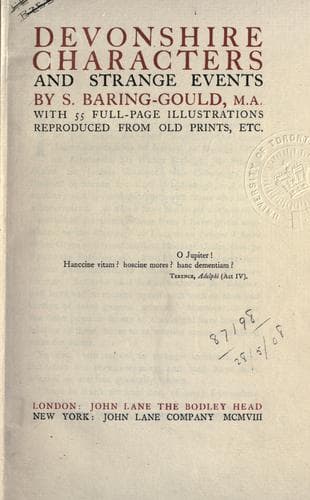
Devonshire Characters and Strange EventsBaring-Gould, S. (Sabine)
History
Devonshire Characters and Strange Events
Baring-Gould, S. (Sabine)
Devon (England) -- Biography; Devon (England) -- History
In 1651 a fine of £300 was put upon Henry Bidlake, and his estates
were sequestrated to the Commonwealth until it should be paid. He had
to borrow money from his friends in order to pay his fine. Money was
lent him by Nicholas Rowe, of Lamerton, by Daniel Hawkins, of Sydenham,
by David Hore, of Coryton, by Prudence Lile, of Lifton, by Richard
Edgecombe, of Milton Abbot, by John Baron, of Lawhitton, and by John
Cloberry, of Bradstone. His mother-in-law, Philippa Kelly, of Kelly,
seems to have repaid these friends, or paid the interest due to them.
As security, Henry Bidlake alienated and sold to her his goods and
chattels, only reserving his wearing apparel. He got back his property
in 1654, but his account with the Parliament seems never to have been
settled, and he was liable to repeated vexations. As late as December,
1658, he received a summons along with his wife, from Richard, Lord
Protector, to appear before the Chancery Court at Exeter. But next year
he died, too early to see--what would have gladdened his heart--the
Restoration, and to have learned by painful experience the ready
forgetfulness by kings of services rendered in the past.
Bidlake House is a very interesting example of a simple mansion such
as suited the small squires of Devon in the seventeenth century. It
is Elizabethan, and has a quaint old garden at the back. Like so many
old houses, the aspect was not considered, and the sun pours into the
kitchen, but hardly a gleam can reach the hall and parlour.
But our ancestors had their reasons for burying their mansions at the
foot of hills, and turning their backs against the sun. The great enemy
was the south-west wind which they could not exclude. It drove through
the walls. Therefore by preference they planted their houses under the
lee of a bank of hill that intervened between them and the south, and
turned their backs like horses against the driving rain.
THE PIRATES OF LUNDY
“In the Bristol Channel,” says Mr. Chanter, “twenty miles from
Barnstaple Bar, and nearly equidistant from the two headlands of the
bay, lies the island of Lundy, sometimes invisible from the shore,
but generally looming dim and mysterious and more or less shrouded
in mists, or capped with cloud-reefs; occasionally standing out
lofty, clear, and distinct, bright with varied hues of rock, fern,
and heather, its granite cliffs glittering as they reflect the rays
of the morning sun, and the graceful lighthouse tower and buildings
plainly defined; or at night traceable by its strange intermittent
light--either suddenly shining out as a star and as suddenly vanishing,
or gradually rising and fading according to the atmospheric conditions;
but in all its aspects, varying much from day to day. And to those who
know how to read them aright, the changing aspects of Lundy are the
surest indications of approaching changes of weather--of winds, storms,
or settled sunshine.
Public-domain text, read in full here on John Shaqi.
Reviews
Reviews
No reviews yet
Be the first to share your thoughts on this work.
Elsewhere in the archive
Join the Discussion
Join the discussion
Sign in to leave a comment or review.
Sign InorCreate an account