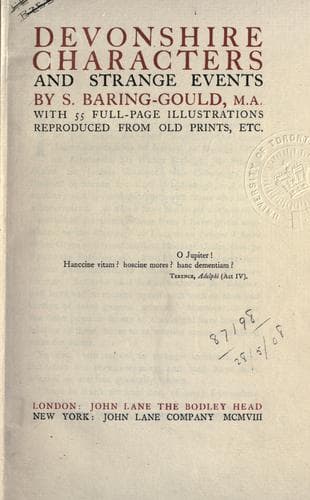
Devonshire Characters and Strange EventsBaring-Gould, S. (Sabine)
History
Devonshire Characters and Strange Events
Baring-Gould, S. (Sabine)
Devon (England) -- Biography; Devon (England) -- History
“As seen nearer the island shows itself a lofty table-headed granite
rock, rising to the height of 500 feet, surrounded by steep and
occasionally perpendicular cliffs, storm-beaten, riven, and scarred
over with grisly seams and clefts, and hollowed out here and there
along the shore into fantastic coves and grottoes, with huge piles
of granite thrown in wild disorder. The cliffs and adjacent sea are
alive with sea-birds, every ledge and jutting rock being dotted with
them, or they are whirling round in clouds, filling the air with their
discordant screams.
“This island, so little known, so little visited, so wild and
mysterious in aspect, possesses an interest in its remote history,
its antiquities, its physical features and peculiarities, and in its
natural history, almost unrivalled.”[7]
Lundy is an outcrop of the granite that heaved up Exmoor on its back,
but there never broke through. Here the superincumbent carboniferous
rocks have been cleared away by the action of the sea, and Lundy stands
forth a naked shaft of granite. It possesses but a single harbour, at
the southern extremity of the island.
Lundy takes its name from the puffins, in Scandinavian _Lund_, that at
all times frequented it; but it had an earlier Celtic name, Caer Sidi,
and is spoken of as a mysterious abode in the Welsh _Mabinogion_.
From an early period, its peculiar position, commanding the entrance to
the Bristol Channel, its inaccessibility, its remoteness, rendered it
a resort of pirates. Thomas Wyke, Canon of Oseney, in 1238, speaks of
it as the haunt of a notable pirate, William de Marisco. This William
had a son Jordan, who held the island in defiance of the King, and
descended from it to make raids on the adjoining coasts. The island had
been granted by Henry II to the Templars, but they had been unable to
dislodge the De Mariscoes and obtain possession of it. A special tax
was levied on the counties of Devon and Cornwall for the siege of Lundy
and the defence of their maritime ports, but it does not seem that
Sir William was ever dispossessed. Marisco was one of the prisoners
captured from the French in a sea fight in 1217, and was afterwards
reinstated in his island, along with his wife and children, who had
also been taken. In 1222 he removed to Lundy some guns he had taken
from his lordship of Camley in Somerset, and, turbulent to the end, he
was, in 1233, amerced in a fine of 300 marks to the King for his ransom.
His younger son, Sir William, was outlawed in 1235 for slaying in
London an Irish messenger. His elder brother Jordan, or Geoffrey, had
made a descent on Ireland and was killed at Kilkenny in 1234.
Sir William got into further trouble on an accusation of an attempt to
assassinate Henry III, and this led to the breaking up of the robbers’
nest, and its being wrested from the Marisco family for many years.
Public-domain text, read in full here on John Shaqi.
Reviews
Reviews
No reviews yet
Be the first to share your thoughts on this work.
Elsewhere in the archive
Join the Discussion
Join the discussion
Sign in to leave a comment or review.
Sign InorCreate an account