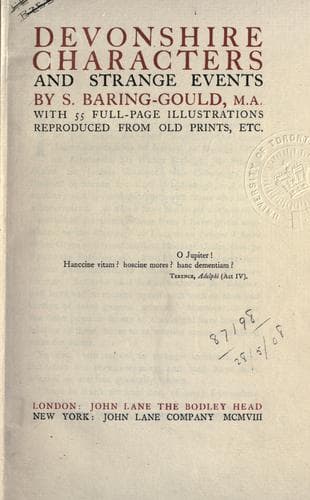
Devonshire Characters and Strange EventsBaring-Gould, S. (Sabine)
History
Devonshire Characters and Strange Events
Baring-Gould, S. (Sabine)
Devon (England) -- Biography; Devon (England) -- History
The evidence incriminating William de Marisco was clearly worthless. If
the would-be assassin had not been insane he would not have asserted
a claim to the crown and drawn attention to himself before making the
murderous attempt. De Marisco had nothing to gain by the King’s death,
and he may certainly be acquitted of participation.
William fled to Lundy, “impregnable from the nature of the place, and
having attached to himself many outlaws and malefactors, subsisted
by piracies, taking more especially wine and provisions, and making
frequent sudden descents on the adjacent lands, spoiling and injuring
the realm by land and by sea, and native as well as foreign merchants.
Many English nobles, having learnt how that the said William and his
followers could not be surprised save by stratagem, apprised the King
that the securing of this malefactor must be effected not by violence,
but by craft. The King therefore ordered his faithful subjects to
exert themselves strenuously in order to capture him and relieve their
country.”
Nothing, however, was done for four years, during which the piracies
continued. There was this excuse for De Marisco, that as the island
grew neither corn nor wine, he was dependent on the mainland or on
merchant vessels for his subsistence. As all those on the mainland were
on the look-out to capture him as the supposed mover of the plot to
kill the King, he was forced to live by piracy. In 1242, William of
Worcester informs us, he was caught: how, he does not say, save that
it was by surprise. “He was thrown into chains, and he and sixteen
accomplices were condemned and sentenced to death. He was executed at
the Tower on a gibbet with special ignominy, his body suspended in a
sack, and when stiff in death, disembowelled, his bowels burnt, and his
body divided into quarters.”
After the execution of Sir William, his father, Geoffrey (or Jordan)
fled to France, and the island was then seized by the King, who
appointed to it governors. But in 1281 Lundy was again granted to a
Marisco, Sir William, son of Jordan, another of the progeny of old
Geoffrey. He died in 1284, and his son John in 1289, leaving Herbert
as his son and heir. But Edward II granted the island to the elder
Despenser, and Herbert was unable to obtain possession of it. He died
in 1327, and from that date no more is heard of the Mariscoes in
connexion with the island.
From their time, however, other pirates obtained a footing on it. In
the days of Henry VIII a gang of French pirates, under their captain,
De Valle, seized Lundy and waylaid the Bristol traders, but the
Clovelly fishermen made an expedition against them, burnt their ship,
and killed or made prisoners of the whole gang.
Public-domain text, read in full here on John Shaqi.
Reviews
Reviews
No reviews yet
Be the first to share your thoughts on this work.
Elsewhere in the archive
Join the Discussion
Join the discussion
Sign in to leave a comment or review.
Sign InorCreate an account