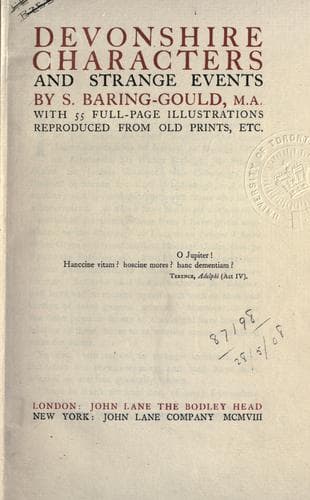
Devonshire Characters and Strange EventsBaring-Gould, S. (Sabine)
History
Devonshire Characters and Strange Events
Baring-Gould, S. (Sabine)
Devon (England) -- Biography; Devon (England) -- History
A few years later, Lord Seymour, High Admiral of England, uncle of
Edward VI, was charged, among other misdemeanours, with trying to get
hold of Lundy, “being aided with shipps and conspiring at all evill
eventes with pirates, (so that) he might at all tymes have a sure and
saufe refuge, if anything for his demerites should have been attempted
against him.” He was executed, having refused to answer the charges
made against him.
In Sir John Maclean’s _Life and Times of Sir Peter Carew, Knt._,
are printed two letters written by Queen Elizabeth in the year 1564,
directing Sir Peter--“forasmuch as that cost of Devonshyre and Cornwall
is by report mucch hanted with pyratts and Rovers ... to cause on or
twoo apt vessells to be made redy with all spede in some portes ther
about.” In the apprehension of such pirates, with her characteristic
economy the Queen bargains that the parties “must take ther benefitt of
y^e spoyle, and be provijded only by us of victell.” She goes a little
further in thriftiness, and suggests that possibly “ye sayd Rovers
might be entyced, with hope of our mercy, to apprehend some of the rest
of ther Company, which practise we have knowen doone good long agoo in
the lyke.”
Although Lundy is not specified in this as the rendezvous of the
pirates, we know that at this time it was so.
In the year 1587 the authorities of Barnstaple appear to have
undertaken on their own account a raid upon the pirates who were
accustomed to shelter themselves under Lundy Island.
Connected with the “setting forth of divers men from this town to
apprehend divers rovers and pirates at Londey,” the following items of
expenditure in the municipal records show that the expedition was not
unsuccessful: “Paid to six watchmen for watching the prisoners that
were taken, 12^s 1^d. Paid for a watch put, and for candlelyght for the
same prisoners, 11^d. Paid for meat and drink for the same prisoners,
2^{sh}.”[8]
Stow tells us that a batch of ten sea-rovers were hanged at once at
Wapping. They distributed among their friends their murrey velvet
doublets with great gold buttons and crimson taffeta, and great
Venetians laid with broad gold lace, “too sumptuous apparel,” Stow
remarks, “which they had worn at the seas.”
In 1608, a commission was issued to the Earl of Bath, who took the
depositions of three persons at Barnstaple, to the effect that the
merchants were daily robbed at sea by pirates who took refuge in Lundy.
In 1610, another commission was issued to the Earl of Nottingham to
authorize the town of Barnstaple to send out ships for the capture of
pirates, and the deposition was taken of one William Young, who had
been made prisoner by Captain Salkeld, who entitled himself “King of
Lundy,” and was a notorious pirate.
Public-domain text, read in full here on John Shaqi.
Reviews
Reviews
No reviews yet
Be the first to share your thoughts on this work.
Elsewhere in the archive
Join the Discussion
Join the discussion
Sign in to leave a comment or review.
Sign InorCreate an account