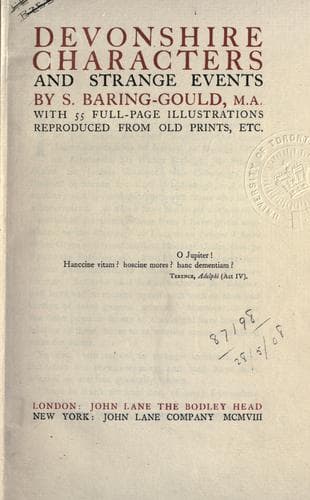
Devonshire Characters and Strange EventsBaring-Gould, S. (Sabine)
History
Devonshire Characters and Strange Events
Baring-Gould, S. (Sabine)
Devon (England) -- Biography; Devon (England) -- History
He wrote plays that were well received for the most part, but all were
tainted with intolerable grossness. But at this period of revulsion
from Puritanism, licentiousness of intrigue, indelicacy of wit, most
strongly appealed to the popular taste, at least in London, and among
the hangers-on of a profligate court. In 1676, he produced _The Siege
of Memphis_ and _The Fond Husband; or, The Plotting Sisters_. In
1677, _Madame Pickle_. In all, down to his death, thirty-two dramatic
pieces. But that which obtained for D’Urfey his greatest reputation
was a peculiarly happy knack that he possessed in writing satires and
songs. In the latter style of composition he knew how to start with a
telling line. There was in his composition a vein of genuine poetry,
but the trail of the serpent was over it all: he could not leave his
best pieces without something foul to spoil it. Many of his songs were
set to music by his friends Henry Purcell, Thomas Farmer, and Dr. John
Blow; but a good many were adapted to folk airs. In 1683, he brought
out his _New Collection of Songs and Poems_, in which was “The Night
her Blackest Sables Wore,” which was afterwards claimed for Francis
Semple, of Beltrees. D’Urfey wrote a good many songs in fancy Scottish
dialect, as a taste for North-country songs came in after James, Duke
of York, afterwards James II, was sent to govern Scotland in 1679 and
1680. Although there can be no doubt whatever as to the authorship of
“The Night her Blackest Sables Wore,” about fifty years after its first
publication the song and tune in a corrupt form appear in Thomson’s
_Orpheus Caledonicus_ (1733), with some change in the words so as to
make it appear to be Scottish, as “She rose and let me in,” altered to
“She raise and loot me in.” Mr. Chappell says: “It is a common error to
suppose that England was inundated with Scotch tunes at the union of
the two Crowns. The first effect was directly the reverse.” In fact, a
stream of English popular melodies flowed into Scotland, and this in a
flood in the reign of Charles II, carrying with them the English words,
which Scottish compilers adapted and appropriated, and these have come
back to us as “made in Scotland,” whereas they are genuine English
songs, words and music and all.
Tom Brown, venomous and scurrilous as Tom D’Urfey was not, lampooned
the latter, and called him “Thou cur, half French, half English breed,”
and mocked him regarding a duel at Epsom, in 1689, with one Bell, a
musician.
I sing of a Duel, in Epsom befell
’Twixt Fa-so-la D’Urfey and Sol-la-mi Bell.
Tom took it in good part. It was only by Jeremy Collier that he could
be prevailed to reply, and even then it was chiefly in a song.
Public-domain text, read in full here on John Shaqi.
Reviews
Reviews
No reviews yet
Be the first to share your thoughts on this work.
Elsewhere in the archive
Join the Discussion
Join the discussion
Sign in to leave a comment or review.
Sign InorCreate an account