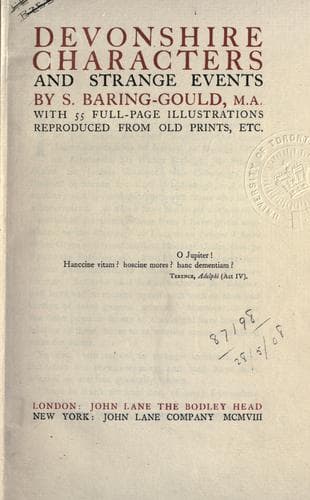
Devonshire Characters and Strange EventsBaring-Gould, S. (Sabine)
History
Devonshire Characters and Strange Events
Baring-Gould, S. (Sabine)
Devon (England) -- Biography; Devon (England) -- History
Jeremy Collier had published in 1697 his famous _Short View of
the Profaneness and Immorality of the English Stage_, which dealt
a terrible blow at what little prosperity the theatres enjoyed,
and aroused a wholesome spirit of resentment against the outrages
committed on the stage against Christian virtue and common decency. The
castigation was well deserved, for the licentiousness of the stage both
before and behind the curtain had become a monstrous evil.
The sensation created by the book was enormous, scores of pamphlets
refuting or defending its views were written, and the falling off
in the audiences plainly showed that its remonstrances had struck
home. D’Urfey was one of those hardest hit; he winced, cried out,
but did not mend. D’Urfey was a good, witty, and genial companion,
and this obtained him favour with a great many persons of all ranks
and conditions. The Duke of Albemarle, son of General Monk, had him
frequently at his table to divert the company; of which he was not a
little vain, as we may gather from part of a song made upon him at that
time:--
He prates like a parrot;
He sups with the Duke,
And he lies in a garret.
Crowned heads condescended to admit him to their presence, and were not
a little diverted by him. It is not surprising to hear this of so merry
a monarch as Charles II; but even King William, so glum and reserved
in temper, and so little appreciative of music, or of any amusements
of that kind, must needs have D’Urfey one night to him; and D’Urfey
extorted a hearty laugh even from him, and departed with a present.
D’Urfey had inherited his grandfather’s Huguenot prejudices; he was a
staunch Protestant in his feelings if not a Christian in his morals,
and he wrote satirical songs against the Roman Catholics, so that
William III felt it well to show him favour.
One of his anti-papal songs, and one that was very popular among the
Whigs, was “Dear Catholic Brother,” and this he set to a very fine
ancient tune, to which to this day “The Hunting of Arscott of Tetcott”
is sung in Devon. But D’Urfey did not take the complete tune, as he did
not need it for his piece of verse, and his incomplete version of the
tune travelled into Wales and Scotland as well as throughout England.
It is an early, genuine English melody in the Dorian mode.
Charles II had leaned familiarly on D’Urfey’s shoulder, holding a
corner of the same sheet of music from which the poet was singing his
burlesque song, “Remember, ye Whigs, what was formerly done.”
Public-domain text, read in full here on John Shaqi.
Reviews
Reviews
No reviews yet
Be the first to share your thoughts on this work.
Elsewhere in the archive
Join the Discussion
Join the discussion
Sign in to leave a comment or review.
Sign InorCreate an account