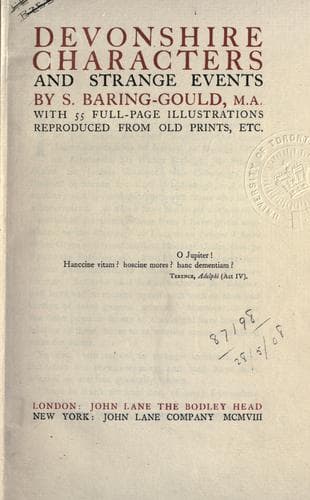
Devonshire Characters and Strange EventsBaring-Gould, S. (Sabine)
History
Devonshire Characters and Strange Events
Baring-Gould, S. (Sabine)
Devon (England) -- Biography; Devon (England) -- History
Writing to Henry Cromwell, 10th April, 1710, Alexander Pope says: “I
have not quoted one Latin author since I came down, but have learned
without book a song of Mr. Thomas Durfey’s, who is your only poet of
tolerable reputation in this country. He makes all the merriment in our
entertainments, and but for him, there would be so miserable a dearth
of catches, that, I fear, they would put either the Parson or me upon
making some of ’em. Any man, of any quality, is heartily welcome to
the best topeing-table of our gentry, who can roar out some rhapsodies
of his works; so that in the same manner as it was said of Homer to
his detractors, What! dares any man speak against him who has given so
many men to _eat_? (meaning the rhapsodists who lived by repeating his
verses). Thus may it be said of Mr. Durfey to his detractors, Dares
any one despise him, who has made so many men _drink_? Alas, Sir! this
is a glory which neither you nor I must ever pretend to. Neither you
with your Ovid, nor I with my Statius, can amuse a board of Justices
and extraordinary Squires, or gain one hum of approbation, or laugh of
admiration. These things (they would say) are too studious, they may do
well enough with such as love reading, but give us your ancient Poet,
Mr. Durfey! ’Tis mortifying enough, it must be confess’d.”
There is a slight allusion to D’Urfey in the _Dunciad_, iii. 146.
Gay mentions that Tom ran his Muse with what was long a favourite
racing song, “To horse, brave boys, to Newmarket, to horse!”
Tom was very irregular in his metres. He had the art of jumbling long
and short quantities so dexterously together that order resulted from
confusion. Of this happy talent he gave various specimens, in adapting
songs to tunes, composing his songs in such measures as scarcely any
instrument but a drum could accompany; as to the tune, it had to
take care of itself. To be even with the musicians who complained of
the irregularity of his metres, and their unusual character, he went
further, composing songs in metres so broken and intricate, that few
could be found who could adapt tunes to them that were of any value. It
is said that he once challenged Purcell to set to music such a song as
he would write, and gave him the ballad that speedily became popular,
“One Long Whitsun Holiday,” which cost the latter more pains to fit
with a tune than the composition of his _Te Deum_.
Tom, at least in the early part of his life, was a Tory by principle,
and never let slip an opportunity of representing his adversaries, the
Whigs, in a ridiculous light. Addison says that the song of “Joy to
Great Cæsar” gave them such a blow that they were not able to recover
during the reign of Charles II.
Public-domain text, read in full here on John Shaqi.
Reviews
Reviews
No reviews yet
Be the first to share your thoughts on this work.
Elsewhere in the archive
Join the Discussion
Join the discussion
Sign in to leave a comment or review.
Sign InorCreate an account