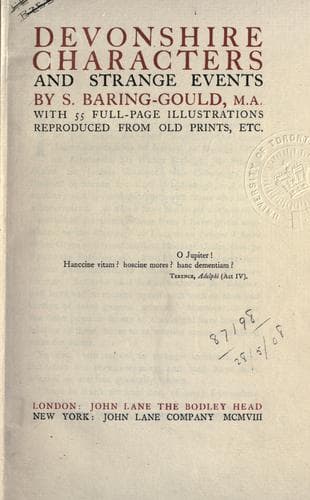
Devonshire Characters and Strange EventsBaring-Gould, S. (Sabine)
History
Devonshire Characters and Strange Events
Baring-Gould, S. (Sabine)
Devon (England) -- Biography; Devon (England) -- History
This song was set to a tune called “Farinelli’s Ground.” Divisions were
made on it by some English master, and it soon became a favourite
air. D’Urfey set words to it in which his old Huguenot execration of
the Papists breaks forth. Farinelli was a Papist, a circumstance that
gave occasion to Addison to remark that his friend Tom had made use
of Italian tunes for promoting the Protestant interest; and turned a
considerable part of the Pope’s music as a battery against the chair of
St. Peter.
D’Urfey’s _Pills to Purge Melancholy_ is a book nowadays to be kept
under lock and key, or else to be bound and lettered “Practical
Sermons,” to avoid its being taken down from its shelf and being looked
into by young people. And yet--“Tempora mutantur et nos mutantur in
illis.” Addison speaks of his songs in No. 67 of _The Guardian_ thus:
“I must heartily recommend to all young ladies, my disciples, the case
of my old friend, who has often made their grandmothers merry, and
whose sonnets have perhaps lulled to sleep many a pleasant toast, when
she lay in her cradle.” In No. 29, 1713, Addison wrote: “A _judicious_
author, some years since, published a collection of sonnets, which
he very successfully called ‘Laugh and be Fat; or, Pills to Purge
Melancholy.’ I cannot sufficiently admire the facetious title of these
volumes, and must censure the world of ingratitude, while they are so
negligent in rewarding the jocose labours of my friend, Mr. D’Urfey,
who was so large a contributor to this treatise, and to whose numerous
productions so many rural squires in the remotest parts of the island
are obliged for the dignity and state which corpulency gives them.”
D’Urfey was the last English poet that appeared in the streets attended
by a page. Many an honest gentleman, it is said, got a reputation in
his county by pretending to have been a boon companion of D’Urfey;
yet, so universal a favourite as he was, towards the latter part of
his life he stood in need of assistance to prevent his passing the
remainder of it in a cage like a singing-bird; for, to use his own
words, “after having written more odes than Horace, and about four
times as many comedies as Terence, he found himself reduced to great
difficulties by the importunities of a set of men who of late years had
furnished him with the accommodations of life, and would not, as we
say, be paid with a song.”
Public-domain text, read in full here on John Shaqi.
Reviews
Reviews
No reviews yet
Be the first to share your thoughts on this work.
Elsewhere in the archive
Join the Discussion
Join the discussion
Sign in to leave a comment or review.
Sign InorCreate an account