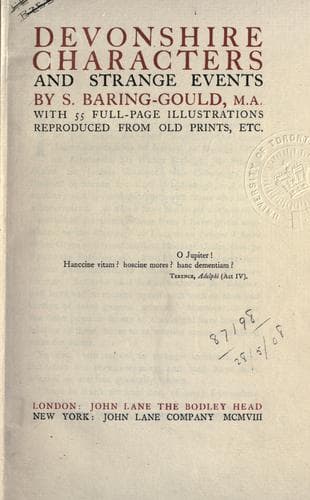
Devonshire Characters and Strange EventsBaring-Gould, S. (Sabine)
History
Devonshire Characters and Strange Events
Baring-Gould, S. (Sabine)
Devon (England) -- Biography; Devon (England) -- History
Addison, to relieve the old man, whose sight was then failing, but
whose spirits had not been extinguished, applied to the directors
of the play-house, and they agreed to act _The Plotting Sisters_,
one of his earliest productions, for the benefit of the author. What
the result of this benefit was does not appear, but it was probably
sufficient to make him easy, as we find him living and continuing to
write with the same humour and liveliness to the time of his death,
which happened on 26 February, 1723. He was buried in the churchyard of
St. James’s, Westminster, against the wall on the south-west angle of
which church, on the outside, was erected a stone to his memory, with
this inscription: “Tom Durfey died Feb. 26, 1723.”
THE BIRD OF THE OXENHAMS
The Lysons brothers, in their _Magna Britannia_, Devon, tell the
following story, under the head of South Tawton: “Oxenham gave its
name to an ancient family, who possessed it at least from the time
of Henry III till the death of the late William Long Oxenham, Esq.,
in 1814. Captain John Oxenham, who had been the friend and companion
of Sir Francis Drake, and who, having fitted out a ship on a voyage
of discovery and enterprise on his own account, lost his life in an
engagement with the Spaniards in South America, in 1575, is supposed
to have been of this family. The family has been remarkable also for
the tradition of a bird having appeared to several of its members
previously to their death. Howell, who had seen mention of this
circumstance on a monument at a stonemason’s in Fleet Street, which
was about to be sent to Devonshire, gives a copy of the inscription
in one of his letters. It is somewhat curious that this letter proves
the fact alleged by Wood, that Howell’s work does not consist of
entirely genuine letters, but that many of them were first written
when he was in the Fleet prison to gain money for the relief of his
necessities. This letter, dated July 3, 1632, relates that, as he
passed by the stonecutter’s shop ‘last Saturday,’ he saw the monument
with the inscription relating the circumstance of the apparition. It
appears, however, by a very scarce pamphlet ... that the persons
whose names are mentioned in the epitaph, given in Howell’s letter,
all died in the year 1635, three years after the date of his letter.
The persons to whom the apparition is stated in the pamphlet to have
appeared were John Oxenham, son of James Oxenham, gentleman, of Zeal
Monachorum, aged twenty-one,[11] and said to have been six feet and
a half in height, who died Sept. 5, 1635, a bird with a white breast
having appeared hovering over him two days before; Thomazine, wife of
James Oxenham, the younger, who died Sept. 7, 1635, aged twenty-two;
Rebecca Oxenham, who died Sept. 9, aged eight years; and Thomazine, a
child in the cradle, who died Sept. 15. It is added that the same bird
had appeared to Grace, the grandmother of John Oxenham, who died 1618.
Public-domain text, read in full here on John Shaqi.
Reviews
Reviews
No reviews yet
Be the first to share your thoughts on this work.
Elsewhere in the archive
Join the Discussion
Join the discussion
Sign in to leave a comment or review.
Sign InorCreate an account