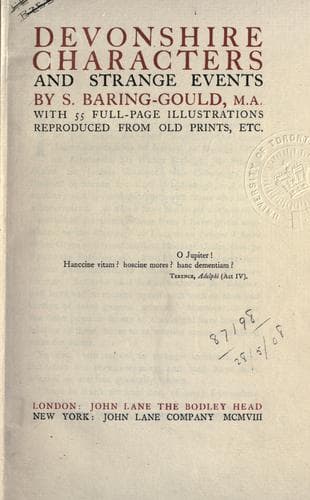
Devonshire Characters and Strange EventsBaring-Gould, S. (Sabine)
History
Devonshire Characters and Strange Events
Baring-Gould, S. (Sabine)
Devon (England) -- Biography; Devon (England) -- History
It will be noticed that Howell has got all the Christian names wrong,
but then, as he states, he gave the inscription from memory. If the
date of the letter be correct, 1632, that, as Lysons pointed out, was
before the deaths that took place in 1635. But in the first edition of
the letters this particular one is undated, and little or no reliance
can be placed on the dates that are given; indeed, the bulk of the
letters, if not all, were written by Howell when in prison and never
had been sent to the persons to whom addressed, any more than at the
dates when supposed to be written. Probably in his second edition he
dated this letter to E. D. sufficiently early to account for his
walking abroad in Fleet Street “last Saturday,” caring only that it
should not appear as a composition written in prison.
That he ever saw the marble monument is improbable, as it is almost
certain that no such monument existed. He had read the tract, and
pretended to have seen the stone so as to furnish a theme for an
interesting letter. It is extremely unlikely that the names of
witnesses to the apparition should be inscribed on the stone. Howell
saw these names in the tract; he did not know who they were, but
supposed them to be squires and ladies. There were no such gentry
about South Tawton at the period. As to the statement made in the
tract that the Bishop had commissioned the vicar of the parish to
examine into the case, and that he and the parson bore testimony to
its genuine character, that is as worthless as the witnessing to the
ballad concerning the “Fish that appeared upon the Coast, on Wednesday
the four score of April, forty thousand fathom above water.... It was
thought she was a woman turned into a cold fish. The ballad is very
pitiful, and as true.... Five justices’ hands at it; and witnesses more
than my pack will hold.”
It was a common trick of ballad-mongers and pamphleteers to add a
string of names of witnesses--all fictitious, every one.
The monument is probably as fictitious as the names of the witnesses.
There is not, and there never was, such in South Tawton Church any more
than in that of Zeal Monachorum. Lysons gives the Oxenham monuments as
he found them there: William Oxenham, gent., 1699; William Oxenham,
Esq., 1743; George Oxenham, Esq., 1779. “It is proper to add,” says
Lysons, “that there is no trace of the Oxenham family, nor of
the monument before mentioned, either in the register, church, or
churchyard of Zeal Monachorum, nor have I been able to learn that it
exists at Tawton, or elsewhere in the county.”
I was at South Tawton in 1854, staying with Mr. T. Burkett, the then
vicar, and I drew some of the monuments in the church, and am certain
this particular stone was neither in the church nor outside.
Public-domain text, read in full here on John Shaqi.
Reviews
Reviews
No reviews yet
Be the first to share your thoughts on this work.
Elsewhere in the archive
Join the Discussion
Join the discussion
Sign in to leave a comment or review.
Sign InorCreate an account