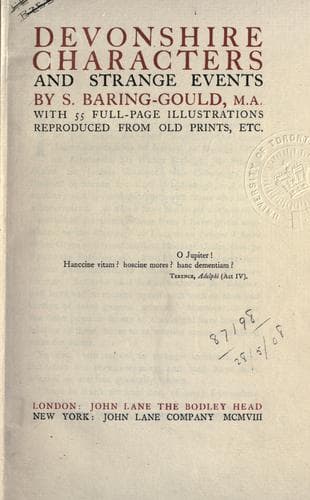
Devonshire Characters and Strange EventsBaring-Gould, S. (Sabine)
History
Devonshire Characters and Strange Events
Baring-Gould, S. (Sabine)
Devon (England) -- Biography; Devon (England) -- History
So also Polwhele, in his _History of Devonshire_, 1793, says: “The
prodigy of the white bird ... seems to be little known at present to
the common people at South Tawton; nor can I find anywhere a trace of
the marble stone which Mr. Howell saw in the lapidary’s shop in London.”
In Sir William Pole’s _Collections_, published in 1791, there stood
originally: “Oxenham, the land of Wm. Oxenham [the father of John,
the grandfather of Will, father of another John, grandfather of
James; whose tombstone respects a strange wonder of this famyly, that
at theire deaths were still seen a bird with a white brest, which
fluttering for a while about theire beds suddenly vanisht away, which
divers of ye same place belive being eyewitnesses of]”.
Sir William Pole died in 1635, and he said not one word about the bird
of the Oxenhams; that which has been placed within brackets was an
addition made by his son, Sir John, who had probably read the pamphlet
or Howell’s Letters. Risdon, who lived not far from South Tawton, knew
nothing about the bird. In fact, the whole legend grew out of the story
in the tract.
That this story is not wholly baseless may be allowed in the one case
of John Oxenham. As he was dying the window very probably was opened,
and a ring ouzel, attracted by the light, may have entered, fluttered
about, and then flown out again. That the window was open I said was
probable, for it is an idea widely spread in England that when a person
is near death the casement should be thrown open so as to allow the
soul to escape. I said once to a nurse who had attended a dying man:
“Why did you open the window?” “You wouldn’t have had his soul go up
the chimney, sir?” was the answer.
The appearance--accidental--of a bird in the death chamber would, in
a superstitious age, be regarded as supernatural. I was attending the
wife of an old coachman who had been with my father and myself. She
was bed-ridden. One day she said to me: “I know I shall go soon, for a
great bird came fluttering at the window.” She did not, however, die
till two months later.
The story of John Oxenham and the bird got about, and then some one
remarked that a similar sort of thing had happened, so it was said,
when the young man’s grandmother died. That sufficed to set the ball
rolling. For the purpose of the pamphleteer, three additional cases
were invented, cases of Oxenhams who never existed, and the account
of the stone was added, so as to give the tale greater appearance of
verisimilitude.
Kingsley introduces the white bird as an omen of the navigator Oxenham.
He was justified as a novelist in predating the tradition which did not
exist in his time, and was hatched out of the tract of 1641.
Public-domain text, read in full here on John Shaqi.
Reviews
Reviews
No reviews yet
Be the first to share your thoughts on this work.
Elsewhere in the archive
Join the Discussion
Join the discussion
Sign in to leave a comment or review.
Sign InorCreate an account