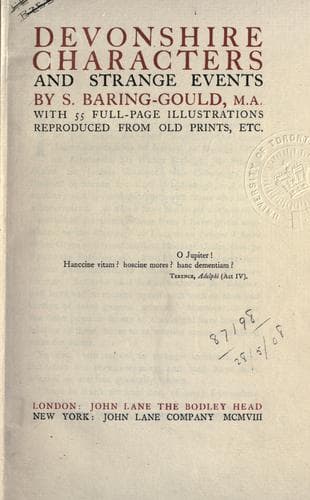
Devonshire Characters and Strange EventsBaring-Gould, S. (Sabine)
History
Devonshire Characters and Strange Events
Baring-Gould, S. (Sabine)
Devon (England) -- Biography; Devon (England) -- History
I have said white bird--for as the story went on the white-breasted
bird became white, hoary with attendance on generations of Oxenhams. It
may be interesting, at all events it is amusing, to note, how out of
this pious hoax serious convictions have grown that the bird really has
been seen, and that repeatedly.
Messrs. Lysons say: “This tradition of the bird had so worked upon the
minds of some of the members of the family, that it is supposed to
have been seen by William Oxenham, who died in 1743.” Then they go on
to relate this particular instance, which is given on the authority of
a note in the manuscript collections of William Chapple. Mr. Chapple
“had the relation from Dr. Bent, who was brother-in-law to Mr. Oxenham,
and had attended him as a physician. The story told is, that when the
bird came into his chambers he observed upon the tradition as connected
with his family, but added, he was not sick enough to die, and that he
should cheat the bird; and that this was a day or two before his death,
which took place after a short illness.”
The story is told more fully in a letter printed in the _Gentleman’s
Magazine_ of April, 1862, from J. Short, Middle Temple, to George
Nares, jun., of Albury.
“I have received an answer from the country in relation to the strange
bird which appeared to Mr. Oxenham just before his death, and the
account which Dr. Bertie gave to Lord Abingdon of it is certainly true.
It first was seen outside the window, and soon afterwards by Mrs.
Oxenham in the room, which she mentioned to Mr. Oxenham, and asked him
if he knew what the bird was. ‘Yes,’ says he, ‘it has been upon my face
and head, and is recorded in history as always appearing to our family
before their deaths; but I shall cheat the bird.’ Nothing more was said
about it, nor was the bird taken notice of from that time; but he died
soon afterwards. However odd this affair may seem, it is certainly
true, for the account was given of it by Mrs. Oxenham herself, but she
never mentions it to any one, unless particularly asked about it, and
as it was seen by several persons at the same time, I can’t attribute
it to imagination, but must leave it as a phenomenon unaccounted for.”
In both these accounts we have the story at second hand. The Hon.
Charles Barker, /LL.D./, was rector of Kenn at the time, and
during his tenure of the rectory, Mrs. Oxenham erected a monument in
the church to her father and mother. But who was the J. Short, Middle
Temple, who wrote the above letter to George Nares, jun., Albury? And
what is more to the point, how came it to be dated December 24th, 1741,
when Mr. William Oxenham, whose death it records, died on 10 December,
1743? Discrepancies and anachronisms meet us at every point in the
story of the Oxenham omen.
Public-domain text, read in full here on John Shaqi.
Reviews
Reviews
No reviews yet
Be the first to share your thoughts on this work.
Elsewhere in the archive
Join the Discussion
Join the discussion
Sign in to leave a comment or review.
Sign InorCreate an account