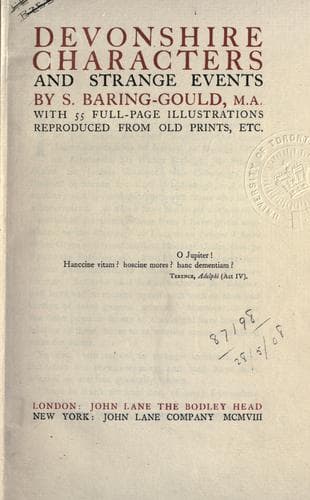
Devonshire Characters and Strange EventsBaring-Gould, S. (Sabine)
History
Devonshire Characters and Strange Events
Baring-Gould, S. (Sabine)
Devon (England) -- Biography; Devon (England) -- History
His life was worked out with great pains and elaboration by the late
Richard Simpson in his _School of Shakespeare_, London, 1878. Indeed,
it occupies one hundred and thirty-nine pages in the first volume of
that work. To give the biography at all fully here is not possible,
space is not at one’s disposal for all details; it is also unnecessary,
since that exhaustive account by Simpson is accessible to every one.
The utmost we can do is to give a summary of the chief events of his
chequered career. Captain Thomas Stucley was the third son of Sir Hugh
Stucley, of Affeton in the parish of West Worlington, near Chumleigh.
Hugh Stucley, the father of our Thomas, was Sheriff of Devon in 1544;
his wife was Jane, daughter of Sir Lewis Pollard. Sir Hugh died in 1560.
The eldest son, Lewis Stucley, was aged thirty at the death of his
father. He became standard-bearer to Queen Elizabeth.
It was rumoured during the life of Thomas that he was an illegitimate
son of Henry VIII, like Sir John Perrot. “Stucley’s birth,” says Mr.
Simpson, “must have occurred at the time when the King, tired of his
wife Catherine, was as yet ranging among favourites who were contented
with something less than a crown as the price of their kindness.
Elizabeth Tailbois had been succeeded by Mary Boleyn; and as Mary
Boleyn was married to William Carey at Court, and in the presence of
the King, 31 January, 1521, it is clear that some one else had already
succeeded to her place.”
Whether Thomas ever claimed to be of royal blood we do not know. If so,
Lady Stucley, like Lady Falconbridge, might have cried out:--
Where is that slave--where is he,
That holds in chase mine honour up and down?
But he was certainly treated at foreign courts as one of birth superior
to that of a younger son of a Devonshire knight; and the tradition
obtains some support from the familiar way in which he was received by
both queens, Mary and Elizabeth, and the peculiar terms of intimacy
which he assumed towards royal personages; moreover the Duke of
Northumberland treated him with the same jealousy with which he might
have treated Henry Fitzroy, Duke of Richmond, had he been still alive.
In the play Vernon says:--
Doubtless, if ever man was misbegot,
It is this Stucley.
As a retainer of the Duke of Suffolk, into whose household he had
entered, and whose livery he wore, he was present at the siege of
Boulogne, 1545-50; and he acted as standard-bearer, with the wage of
six shillings and eightpence a day, from 1547 until its surrender to
the French in March, 1549-50. Then he returned to England, and attached
himself closely to the Protector Somerset.
Public-domain text, read in full here on John Shaqi.
Reviews
Reviews
No reviews yet
Be the first to share your thoughts on this work.
Elsewhere in the archive
Join the Discussion
Join the discussion
Sign in to leave a comment or review.
Sign InorCreate an account