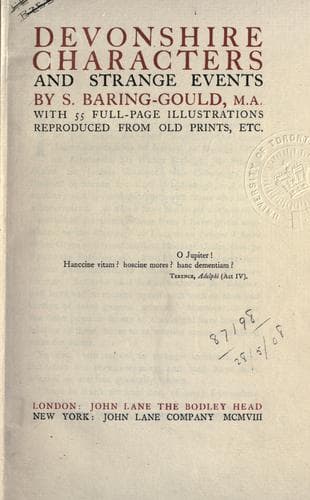
Devonshire Characters and Strange EventsBaring-Gould, S. (Sabine)
History
Devonshire Characters and Strange Events
Baring-Gould, S. (Sabine)
Devon (England) -- Biography; Devon (England) -- History
As one of the Protector’s retainers, he was probably involved in his
plot to revolutionize the government. The gendarmerie upon the muster
day were to be attacked by two thousand men under Sir Ralph Vane, and
by a hundred horse of the Duke of Somerset’s, besides his friends, who
were to stand by, and the idle people who, it was calculated, would
take part. After this was done, the Protector intended to run through
the city and proclaim, “Liberty! Liberty!” But the plot was discovered
in time, and Somerset and his chief accomplices were committed to
the Tower, 17 October, 1551. The Council gave orders for Stucley’s
apprehension, but he escaped in time, and took refuge in France, where
he devoted his sword to the service of Henry II, who entitled him “mon
cher et bon ami.”
He must have fought in the campaign of Henry against the Emperor
Charles V in 1552, when Metz was taken by fraud. He was certainly
received as a disaffected subject, and was admitted to the French
counsels. In 1552 he returned to England with a story which he hoped
would purchase his pardon. This was to the effect that Henry II
meditated a sudden attack upon Calais.
According to his account the French King himself had spoken to him
of the weak points in the defences, had pointed out the very plan of
assault by which, six years later, Calais was actually taken. Moreover,
according to his scheme, the Scots were to enter Northumberland; Henry
II would land troops at Falmouth, and the Duke of Guise would land at
Dartmouth, which he knew to be undefended. Cecil suggested that Stucley
should be sent back to France to acquire further information; but the
Duke of Northumberland sent Stucley’s report to the French King, and
committed Stucley to the Tower. Henry denied the truth of what had been
reported. The payment of his debts, which had been promised to Stucley
as a reward for his revelations, was now refused, and he remained in
prison to the end of Edward’s reign. He was released on 6 August, 1553,
but his debts compelled him again to leave England. Unable to return
to France, he betook himself to the Emperor, and he was at Brussels in
the winter of 1553-4, and served with the Imperial army at St. Omer.
Philibert, Duke of Savoy, invited Stucley to accompany him to England
in October of 1554, and Stucley accordingly appealed to Queen Mary for
security against arrest whilst in her dominions, and this was granted
to him for six months, and at the end of December he accompanied the
Duke to England.
Public-domain text, read in full here on John Shaqi.
Reviews
Reviews
No reviews yet
Be the first to share your thoughts on this work.
Elsewhere in the archive
Join the Discussion
Join the discussion
Sign in to leave a comment or review.
Sign InorCreate an account