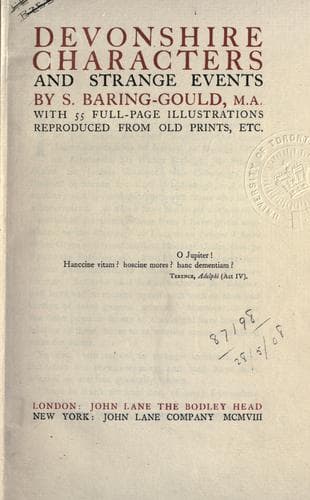
Devonshire Characters and Strange EventsBaring-Gould, S. (Sabine)
History
Devonshire Characters and Strange Events
Baring-Gould, S. (Sabine)
Devon (England) -- Biography; Devon (England) -- History
Fuller says that, “having prodigally misspent his Patrimony, he entered
on several projects (the issue-general of all decaied estates), and
first pitched on the peopling of Florida, then newly found in the West
Indies. So confident his ambition, that he blushed not to tell Queen
Elizabeth ‘that he preferred rather to be sovereign of a Mole-hill
than the highest Subject to the greatest King in Christendom’; adding,
moreover, ‘that he was assured he should be a Prince before his
death.’ ‘I hope,’ said Queen Elizabeth, ‘I shall hear from you, when
you are seated in your Principality.’ ‘I will write to you,’ quoth
Stucley. ‘In what languidge?’ said the Queen. He returned, ‘In the
style of Princes, _To our dear Sister_.’”
He took leave of the Queen on 25 June, 1563. Cecil wrote in her name
to the Earl of Sussex, Lord Deputy of Ireland: “Our servant Thomas
Stucley, associated with sundry of our subjects, hath prepared a number
of good ships well armed and manned to pass to discover certain lands
to the West towards Florida, and by our licence hath taken the same
voyage.” But in the event of stormy winds or accidents he was to be
well received, should he put into a port in Ireland.
So he sailed, but Stucley had no real intention of going to Florida:
his squadron lived by piracy on the high seas for two years. He made
his head-quarters at Kinsale, where he resumed acquaintance with Shan
O’Neil, chief of Tyrone, who aspired to be king of Ulster, and was
repeatedly in arms against the English. Shan had offered Ireland as
a fief to Philip II of Spain. And now Stucley from Kinsale swept the
seas, and made prizes of Spanish galleons, and of French and Portuguese
merchantmen. Complaints were made by the foreign courts, and the
English Ambassador at Madrid confessed that “he hung his head for
shame.” Stucley filled his cellars with sherry from Cadiz, and amused
Shan O’Neil with his boastful speech, his flattery, and his utterance
of what he would do for him; and Shan had the impertinence to write to
Elizabeth in favour of “his so dearly loved friend, and her Majesty’s
worthy subject.”
In June, 1563, Stucley took a Zealand ship with £3000 worth of linen
and tapestry, and then, joining a small fleet of West-countrymen,
fourteen sail in all, he lay off Ushant, watching for the wine fleet
from Bordeaux professedly, but picking up gratefully whatever the gods
might send. No less a person than the Mayor of Dover himself was the
owner of one of these sea-hawks. Wretched Spaniards flying from their
talons were dashed to pieces upon the granite cliffs of Finisterre.
At length the remonstrances of foreign ambassadors took effect, and
Elizabeth disowned Stucley, and took measures for his apprehension.
Some ships were sent out with this object, and he was caught in Cork
harbour, in 1565, put under arrest, and sent to London, where he was
consigned to the Tower.
Public-domain text, read in full here on John Shaqi.
Reviews
Reviews
No reviews yet
Be the first to share your thoughts on this work.
Elsewhere in the archive
Join the Discussion
Join the discussion
Sign in to leave a comment or review.
Sign InorCreate an account