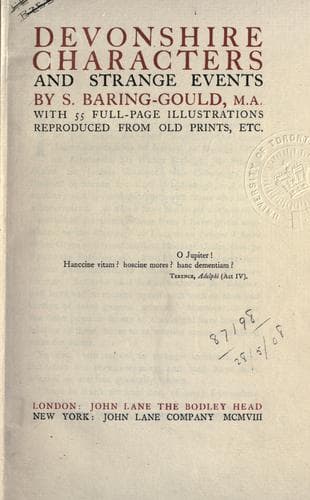
Devonshire Characters and Strange EventsBaring-Gould, S. (Sabine)
History
Devonshire Characters and Strange Events
Baring-Gould, S. (Sabine)
Devon (England) -- Biography; Devon (England) -- History
During his visit he attempted, Othello-like, to bewitch Anne, the
grand-daughter and sole heiress of Sir Thomas Curtis, a wealthy
alderman of London, with his tales of adventure. Against her father’s
wishes the lady was beguiled into a secret marriage, and he retired
with her to North Devon. On 13 May, 1555, the sheriffs of Devon and
Cheshire were ordered to arrest him on a charge of coining false money.
His house was searched, his servants questioned. There was much that
was suspicious, but nothing certainly to convict. But Thomas Stucley
had taken himself off before the sheriff arrived, and again took
service under the Duke of Savoy, and shared in the victory of the
Imperialists over the French at St. Quintin, 10 December, 1557.
Then he went into the Spanish service, but in November old Sir Thomas
Curtis died, brokenhearted, it was asserted, at the match his favourite
grandchild had contracted with one so disreputable and unprincipled.
Stucley at once returned to England, and a correspondent of Challoner,
the Ambassador in Spain, writes of him in November, 1559: “The
Alderman Curtes is dead, and by this time is busy Stucley in the
midst of his coffers.” Speedily the accumulations of the merchant’s
industrious life were squandered in extravagance. We next hear of him
in April, 1561, when he was appointed to a captaincy in Berwick. There
he entertained Shan O’Neil, a famous, turbulent chief from Ireland, who
late in this year visited Elizabeth’s Court, where his train of kerns
and gallowglasses, clothed in linen kilts dyed with saffron, made a
great impression.
While at Court, Shan wrote to Elizabeth: “Many of the nobles, magnates,
and gentlemen treated me kindly and ingenuously, and, namely, Master
Thomas Stucley entertained me with all his heart, and with all the
favour he could.” The friendship was destined to bear fruit later.
In a few years but little of the alderman’s savings remained, and with
the wreck that was left, Stucley fitted out a small squadron, and
obtained permission from Elizabeth to colonize Florida; and the Queen
contributed “2000 weight of corn-powder, and 100 curriers; and besides
artillery to the value of £120 towards the furniture of his journey.”
This was her investment in the venture, though she did not furnish the
powder out of her own stores, but made one Bromefield go into debt for
it with a Dutchman.
Public-domain text, read in full here on John Shaqi.
Reviews
Reviews
No reviews yet
Be the first to share your thoughts on this work.
Elsewhere in the archive
Join the Discussion
Join the discussion
Sign in to leave a comment or review.
Sign InorCreate an account