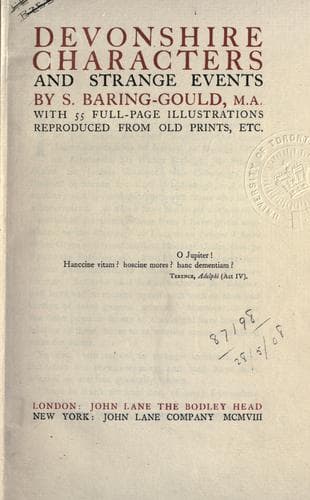
Devonshire Characters and Strange EventsBaring-Gould, S. (Sabine)
History
Devonshire Characters and Strange Events
Baring-Gould, S. (Sabine)
Devon (England) -- Biography; Devon (England) -- History
For two hours Cary was compelled to remain and watch the death and
burning of the little girl, and again attempts were made to wring
a confession from her. Such she steadily and persistently put from
her. When the word went forth to dispatch her, the executioner could
not be found. He had run off with the halter under the cliffs; and,
on being found, was carried by the exploring party to the scene and
cast dead-drunk at the foot of the gallows, there to sleep off his
intoxication, whilst the nurse was still pestered by the Nonconforming
ministers to repent and confess.
But the last words she uttered before being swung into the air were:
“Judge and revenge my cause, O God.” “A sure proof,” concluded Quicke,
“that she went into the lake of brimstone and fire, there to be
tormented for ever and ever.”
We are inclined to judge otherwise, and that she was guiltless of
intent to poison the Weeks family. This was done by the child, in a
fit of temper and resentment. Only after this had been done, did Cary
find it out, and, frightened for the consequences, simulated sickness
and cramps, lest she should be accused of the poisoning. As to Quicke’s
statement that on the ride into Plymouth she used obscene and ribald
jests, we do not believe a word of it. He was furious against her
because she would not confess; and he was not with her on the ride
to hear what her words were. He invented this, and put it into his
narrative to prejudice the reader against her who was not amenable to
his exhortations, and who accordingly galled his self-conceit.
The authorities for this tragic story are three:--
“Horrid News of a Barbarous Murder committed at Plimouth ... 1676.”
“Hell Open’d, or the Infernal Sin of Murther Punished. Being a True
Relation of the Poysoning of a whole Family in Plymouth ... by J. Q.
(John Quicke), Minister of the Gospel. London, 1676.”
“The Poysoners Rewarded, or the Most Barbarous of Murthers detected and
Punished ... London, 1687.”
Mr. Whitfeld has summed them up in his book, _Plymouth and Devonport,
in War and Peace_. Plymouth, 1900.
JACK RATTENBURY
The coasts of Devon and Cornwall, north and south, are bold, with
cliffs starting out of the sea, white near the Dorset frontier, then
red, and then of limestone marble, or, on the north coast, of slate
and schist. The rocks are riddled with caves, the highland is cleft by
narrow valleys sawn through their mass by descending streams. The whole
coast, north and south, lends itself to smuggling; and smuggling had
been carried on as a profitable speculation till it ceased to pay, when
heavy duties were removed, and when the coastguard became efficient.
Public-domain text, read in full here on John Shaqi.
Reviews
Reviews
No reviews yet
Be the first to share your thoughts on this work.
Elsewhere in the archive
Join the Discussion
Join the discussion
Sign in to leave a comment or review.
Sign InorCreate an account