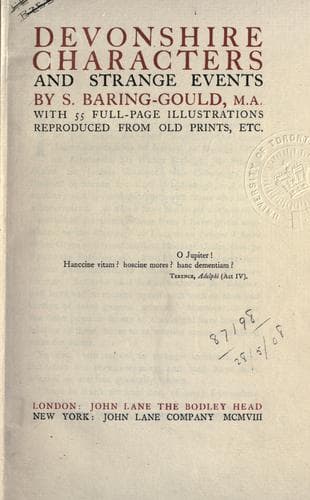
Devonshire Characters and Strange EventsBaring-Gould, S. (Sabine)
History
Devonshire Characters and Strange Events
Baring-Gould, S. (Sabine)
Devon (England) -- Biography; Devon (England) -- History
The smugglers formerly ran their goods into the caves when the weather
permitted, or the preventive men, nicknamed _picaroons_, were not on
the look-out. They stowed away their goods in the caves, and gave
notice to the farmers and gentry of the neighbourhood, all of whom
were provided with numerous donkeys, which were forthwith sent down
to the _caches_, and the kegs and bales were removed under cover of
night or of storm. Few farmhouses and squires’ mansions were not also
provided with hiding-places in which to store the kegs obtained from
the free-traders. Only the week before writing this I was shown one
such in the depth of a dense wood, at Sandridge Park on the Dart;
externally it would have been taken for a natural mound or a tumulus.
But there are a concealed door and a descent by a flight of steps into
the subterranean cellar, that was carefully vaulted, and also carefully
drained.
The other day I saw an old farmhouse in process of demolition in the
parish of Altarnun, on the edge of the Bodmin Moors. The great hall
chimney was of unusual bulk, bulky as such chimneys usually are; and
when it was thrown down it revealed the explanation of this unwonted
size. Behind the back of the hearth was a chamber fashioned in the
thickness of the wall to which access might have been had at some time
through a low walled-up doorway, that was concealed behind the kitchen
dresser and plastered over. This door was so low that it could be
passed through only on all fours.
Now the concealed chamber had also another way by which it could be
entered, and this was through a hole in the floor of a bedroom above.
A plank of the floor could be lifted, when an opening was disclosed
by which any one might pass under the wall through a sort of door and
down steps into this apartment, which was entirely without light. Of
what use was this singular concealed chamber? There could be little
question. It was a place in which formerly kegs of smuggled spirits and
tobacco were hidden. The place lies some fourteen or fifteen miles from
Boscastle, a dangerous little harbour on the North Cornish coast, and
about a mile off the main road from London, by Exeter and Launceston,
to Falmouth. The coach-travellers in old days consumed a good deal of
spirits, and here in a tangle of lanes lay a little emporium always
kept well supplied with a stock of spirits which had not paid duty, and
whence the taverners along the road could derive the contraband liquor,
with which they supplied the travellers. Between this emporium and
the sea, the roads--parish roads--lie over wild moors or creep between
high hedges of earth on which the traveller can step along when the
lane below is converted into the bed of a stream, also on which the
wary smuggler could stride, and keep a look-out whilst his laden mules
and asses stumbled forward in the concealment of the deep-set lane.
[Illustration: JOHN RATTENBURY.
of Beer, Devonshire
“THE ROB ROY of the WEST”]
Public-domain text, read in full here on John Shaqi.
Reviews
Reviews
No reviews yet
Be the first to share your thoughts on this work.
Elsewhere in the archive
Join the Discussion
Join the discussion
Sign in to leave a comment or review.
Sign InorCreate an account