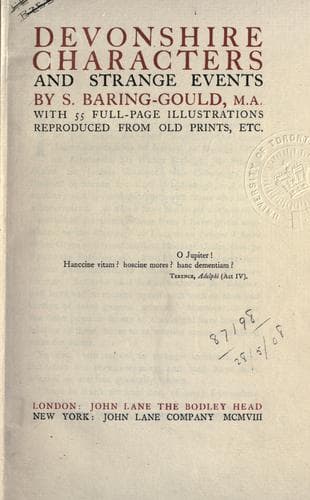
Devonshire Characters and Strange EventsBaring-Gould, S. (Sabine)
History
Devonshire Characters and Strange Events
Baring-Gould, S. (Sabine)
Devon (England) -- Biography; Devon (England) -- History
A very noticeable feature of the Devon and Cornwall coasts is the
trenched and banked-up paths from the little coves. By these paths the
kegs and bales were removed under cover of night.
As an excuse for keeping droves of donkeys, it was pretended that the
sea-sand and the kelp served as admirable dressing for the land; and
no doubt so they did; the trains of asses sometimes came up laden with
sacks of sand, but not infrequently with kegs of brandy.
Now a wary preventive man might watch too narrowly the proceedings of
these trains of asses. Accordingly squires, yeomen, farmers alike set
to work to cut deep ways in the face of the downs, along the slopes of
the hills, and bank them up, so that whole caravans of laden beasts
might travel up and down absolutely unseen from the sea and greatly
screened from the land side.
Undoubtedly the sunken ways and high banks are a great protection
against the weather. So they were represented to be--and no doubt
greatly were the good folks commended for their consideration for the
beasts and their drivers, in thus at great cost shutting them off from
the violence of the gale. Nevertheless, it can hardly be doubted that
concealment from the eye of the coastguard was sought by this means
quite as much as, if not more than the sheltering the beasts of burden
from the weather.
A few years ago, an old church-house in my own parish was demolished.
The church-house was originally the place where the parishioners from
a distance, in a country district, put up between the morning and
afternoon services on the Sunday, and was used for “church ales,” etc.
It was always a long building of two stories; that below served for
the men, that above for the women, and each had its great fireplace.
Here they ate and chattered between services, as already said, and
here were served with ale by the sexton or clerk. In a great many
cases these church-houses have been converted into taverns. Now this
one in the writer’s parish had never been thus altered. When it was
pulled down, it was found that the floor of large slate slabs in the
lower room was undermined with hollows like graves, only of much larger
dimensions--and these had served for the concealment of smuggled
spirits. The clerk had, in fact, dug them out, and did a little trade
on Sundays with selling contraband liquor from these stores.
The story is told of a certain baronet near Dartmouth, now deceased,
who had a handsome house and park near the coast. The preventive men
had long suspected that Sir Thomas had done more than wink at the
proceedings of the receivers of smuggled goods. His park dipped in
graceful undulations to the sea and to a lovely creek, in which was
his boathouse. But they never had been able to establish the fact that
he favoured the smugglers, and allowed them to use his grounds and
outbuildings.
Public-domain text, read in full here on John Shaqi.
Reviews
Reviews
No reviews yet
Be the first to share your thoughts on this work.
Elsewhere in the archive
Join the Discussion
Join the discussion
Sign in to leave a comment or review.
Sign InorCreate an account