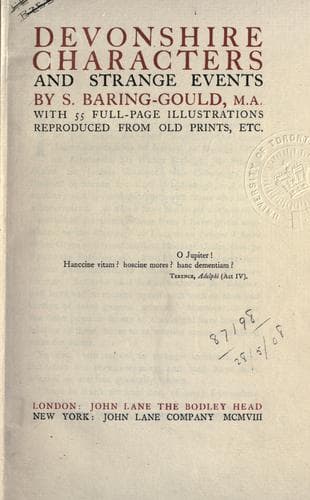
Devonshire Characters and Strange EventsBaring-Gould, S. (Sabine)
History
Devonshire Characters and Strange Events
Baring-Gould, S. (Sabine)
Devon (England) -- Biography; Devon (England) -- History
One of them escaped, but the other two, including the taverner, were
retaken next morning, and both were sentenced to die. The narrative
proceeds to state that “there were many Women of Quality in Exeter that
made great intercession for the said innkeeper to get him a Reprieve,
not so much for his sake, as out of charity to his poor innocent Wife
and Children; for she was generally reputed a very good, careful,
industrious and pious Woman, and hath no less than nine very hopeful
children; but the nature of the Crime excluded him from mercy in this
World, so that he and his Comrade were on Tuesday, the 13th of this
instant August (1678), conveyed to the usual place of Execution, where
there were two that presently suffered; but the Innkeeper, desiring
two hours’ time the better to prepare himself, had it granted, which
he spent in prayer and godly conference with several Ministers; then,
coming upon the ladder, he made a long Speech, wherein he confessed not
only the Crime for which at present he suffered, but likewise divers
other sins, and particularly lamented that his Hypocrisie, earnestly
begging the Spectators’ prayers, and exhorting them not to despair
in any condition ... and so with all the outward marks of a sincere
Penitent, submitted to his sentence, and was executed.”
Dr. Lake, whose _Diary_ has been published by the Camden Society,
happened to be visiting a prisoner in the gaol when Barnes and his
accomplice were brought in. The doctor says that he was “a notorious
Presbyterian,” and that “the evening before hee went forth to execute
his design”--of robbing the carrier--“hee pray’d with his family two
hours.”
The authority for this story is a unique tract in the Bodleian Library,
Oxford, of which the late Robert Dymond, of Exeter, made a copy, and to
which he refers in his paper on “The Old Inns and Taverns of Exeter,”
in the _Transactions_ of the Devonshire Association for 1880.
EDWARD CAPERN
The Postman Poet, Edward Capern, has been hailed as the Devonshire
Burns, but he has no right to be so entitled. Burns, at his best, sang
in the tones and intonation of his class and country, and it was at
his worst that he affected the style of the period and of culture,
such as it was. Now Capern aspired to the artificiality and smoothness
of the highly educated and wholly unreal class of verse writers of
the Victorian period, of whom John Oxenford may be thrust forward as
typical, men who could turn out smooth and finished pieces, rhythm and
rhyme correct, but without a genuine poetical idea forming the kernel
of the “poem.”
What can be said for verses that begin as this to the Wild Convolvulus?
Upon the lap of Nature wild
I love to view thee, Beauty’s child;
And mark the rose and lily white
Their charms in thy fair form unite.
And this to the White Violet?
Public-domain text, read in full here on John Shaqi.
Reviews
Reviews
No reviews yet
Be the first to share your thoughts on this work.
Elsewhere in the archive
Join the Discussion
Join the discussion
Sign in to leave a comment or review.
Sign InorCreate an account