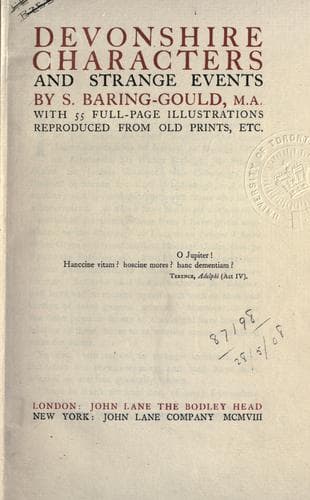
Devonshire Characters and Strange EventsBaring-Gould, S. (Sabine)
History
Devonshire Characters and Strange Events
Baring-Gould, S. (Sabine)
Devon (England) -- Biography; Devon (England) -- History
Pale Beauty went out ’neath a wintry sky
From a nook where the gorse and the holly grew by,
And silently traversed the snow-covered earth
In search of a sign of floriferous birth.
And this to an Early Primrose?
Pretty flow’ret, sweet and fair,
Pensive, weeping, withering there;
Storms are raging, winds are high,
I fear thy beauty soon will die.
Who is not familiar with this sort of stuff? It is to be found in
“Keepsakes,” in those old pocket-books in leather, with a dozen badly
engraved steel-plate landscape scenes at the beginning, and a budget of
verses and rhapsodies that follow, before we come to the calendar and
the sheets for notes.
Of himself, Capern wrote:--
He owns neither houses nor lands,
His wealth is a character good;
A pair of industrious hands,
A drop of poetical blood.
It was a drop, and a small drop. He had an ear for rhythm; he had a
warm appreciation of Nature; he had sentiment--but not ideas, the germs
of mental life to be carried on from generation to generation. The
leaves of poetic expression, graceful diction, fade and wither. It is
ideas alone that are the fruit of the tree of mental life that will
survive. Of such we find none in Capern’s volumes.
His verses are very creditable to the man, considering his position,
but he is not to be named in the same breath with Robert Burns and
Edwin Waugh. Capern had the poetic faculty, but he trod wrong paths,
with the result that nobody henceforth will read his verses, which are
not likely to be republished. Edward Capern was born at Tiverton on 21
January, 1819, where his father carried on business as a baker. When
Edward was about two years old, the family removed to Barnstaple, and
his mother becoming bed-ridden, young Edward, then about eight years
old, found employment at a local lace factory, toiling often, for a
scanty wage, twenty out of the twenty-four hours. The long hours and
the trying nature of the work permanently injured his eyesight, and
seriously affected his after life.
Compelled to abandon his work in the factory in 1847, he ultimately
obtained the post of letter-carrier from Bideford to Buckland Brewer
and its neighbourhood, distributing the mail through a discursive walk
of thirteen miles daily, and receiving a salary of half a guinea per
week.
[Illustration: EDWARD CAPERN, THE POSTMAN-POET OF DEVONSHIRE
_From a painting by William Widgery, in the Free Library, Bideford_]
Capern’s first book of Poems was published in 1856. A Mr. W. F. Rock,
having seen his verses, thought there was merit in them, and undertook
to collect subscribers; and by worrying certain noblemen into taking
four, five, or six copies, and canvassing through the county, he
succeeded in getting enough subscribers to enable him to publish.
But Capern wanted to have all he had written included. Mr. Rock had to
be firm.
Public-domain text, read in full here on John Shaqi.
Reviews
Reviews
No reviews yet
Be the first to share your thoughts on this work.
Elsewhere in the archive
Join the Discussion
Join the discussion
Sign in to leave a comment or review.
Sign InorCreate an account