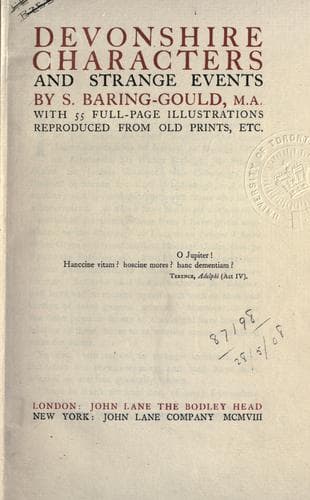
Devonshire Characters and Strange EventsBaring-Gould, S. (Sabine)
History
Devonshire Characters and Strange Events
Baring-Gould, S. (Sabine)
Devon (England) -- Biography; Devon (England) -- History
“What!” exclaimed Capern. “Exclude my ‘Morning’ and the ‘Apostrophe to
the Sun’! Why, sir, I wrote those pieces when I had but four shillings
a week to live upon, which gave but frugal meals.”
Precisely, but that did not constitute them poems. Mr. Rock says: “It
is not my intention even to touch upon the trying incidents of Mr.
Capern’s early life. He is a rural letter-carrier ... for which his
salary is ten shillings and sixpence per week. He has a real poet’s
wife; his Jane, a charming brunette, is intelligent, prudent, and good.
He has two children, Charles, a boy of seven, and Milly, a girl just
three years of age.
“Mr. Capern’s features have a striking resemblance to those of Oliver
Goldsmith; he has also the Doctor’s sturdy build, though not his
personal height. Nor is this the only point of resemblance to our dear
Goldy. Mr. Capern has an ear for music, he plays touchingly on the
flute, and sings his own songs to his own tunes with striking energy or
tenderness.”
He certainly enjoyed his life as a postman. He says:--
O, the postman’s life is as happy a life
As any one’s, I trow;
Wand’ring away where dragon-flies play,
And brooks sing soft and low;
And watching the lark as he soars on high,
To carol in yonder cloud,
“He sings in his labours, and why not I?”
The postman sings aloud.
In 1858, Capern published a second volume, entitled _Ballads and
Songs_, and in 1865 a third, _Wayside Warbles_. There was yet another,
_The Devonshire Melodist_, in which he set his own songs to tunes of
his own composition. But here again he was at fault. Devonshire is full
of folk music of the first order. Burns set his songs to folk tunes
then sung by the people, but to gross words. He rescued the melodies
by giving to them verses that could be sung by decent and clean-minded
people. Now had Capern done this for the music of the neighbourhood of
Barnstaple he would have been remembered along with these delicious
airs, as is Burns along with the Scotch melodies. But not so, he must
set his verses to the tootling of his own pipe, entirely without
melodious idea in the tunes.
Probably Edward Capern had never heard of Edwin Waugh, who wrote the
most delicious, simple, and sweet poems in Lancashire and Yorkshire
dialect; every one is a gem. Probably, had he seen these, Capern would
have despised them. They breathe the life, the passion, the tenderness,
the genius of the North-countrymen. Capern’s verses have none of this
merit. They are respectable _vers de société_, such as any man of
culture could have written. His great achievement was, that, not being
a man of culture, he could write such respectable “poems.” He took a
wrong course from the outset; and unhappily he maintained it. What
tells its own tale is this. Next to the British Museum, the London
Library is the largest in the Metropolis, and it has not been deemed
worth while to include in it one of Capern’s volumes of verses.
Public-domain text, read in full here on John Shaqi.
Reviews
Reviews
No reviews yet
Be the first to share your thoughts on this work.
Elsewhere in the archive
Join the Discussion
Join the discussion
Sign in to leave a comment or review.
Sign InorCreate an account