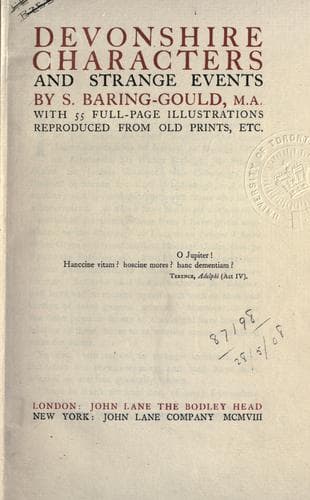
Devonshire Characters and Strange EventsBaring-Gould, S. (Sabine)
History
Devonshire Characters and Strange Events
Baring-Gould, S. (Sabine)
Devon (England) -- Biography; Devon (England) -- History
In the early days of May, 1797, Parker reached the Nore, a point of
land dividing the mouth of the Thames and the Medway. Probably on
account of his former experience as a seaman, he was drafted on board
the _Sandwich_, the guardship that bore the flag of Admiral Buckner,
the Port Admiral. The mutinous spirit which afterwards broke out
certainly existed on board the Nore squadron before Parker’s arrival.
Communications were kept up in secret between the various crews, and
the mischief was gradually drawing to a head. But though he did not
originate the feeling of insubordination, the ardent temper, boldness,
and superior intelligence of Parker soon became known to his comrades,
and he became a prominent man among them. Their plans being at last
matured, the seamen rose simultaneously against their officers, and
deprived them of their arms, as well as of all command in the ships,
though behaving respectfully to them in all other ways. Each vessel
was put under the government of a committee of twelve men, and, to
represent the whole body of seamen, every man-of-war appointed two
delegates and each gunboat one to act for the common good. Of these
delegates Richard Parker was chosen president, and in an unhappy hour
for himself he accepted the office. The representative body drew up a
list of grievances, of which they demanded the removal, offering return
immediately after to their duty. The demands were for increased pay,
better and more abundant food, a more equal division of prize-money,
liberty to go on shore, and prompt payment of arrears. A committee of
naval inquiry subsequently granted almost all their demands, thereby
acknowledging their justice. Parker signed these documents, and they
were published over the whole kingdom with his name attached, as well
as presented to Port Admiral Buckner, through whom they were sent to
the Government. When these proceedings commenced the mutineers were
suffered to go on shore, and they paraded the streets of Sheerness,
where lay a part of the fleet, with music and the red flag flying.
But on the 22nd of May, troops were sent to Sheerness to put a stop
to these demonstrations. Being thus confined to their ships, the
mutineers, having come to no agreement with Admiral Buckner, began
to take more decisive measures for extorting compliance with their
demands, as well as for securing their own safety. The vessels at
Sheerness moved down to the Nore, and the combined force of the
insurgents, which consisted of twenty-five sail, proceeded to block
up the Thames, by refusing a free passage, up or down, to the London
trade. Foreign vessels, and a few small craft, were suffered to go
by, after having received a passport, signed by Richard Parker, as
president of the delegates.
Public-domain text, read in full here on John Shaqi.
Reviews
Reviews
No reviews yet
Be the first to share your thoughts on this work.
Elsewhere in the archive
Join the Discussion
Join the discussion
Sign in to leave a comment or review.
Sign InorCreate an account