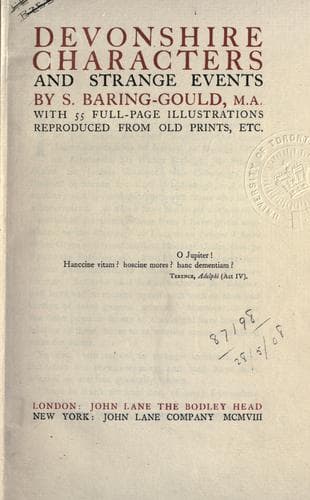
Devonshire Characters and Strange EventsBaring-Gould, S. (Sabine)
History
Devonshire Characters and Strange Events
Baring-Gould, S. (Sabine)
Devon (England) -- Biography; Devon (England) -- History
In a day or two the mutineers had an immense number of vessels under
detention. The mode in which they kept them was as follows: The ships
of war were ranged in a line, at considerable distances from each
other, and in the interspaces were placed the merchant vessels, having
the broadsides of the men-of-war pointed to them. The appearance of
the whole assemblage is described as having been at once grand and
appalling. The red flag floated from the mast-head of every one of the
mutineer ships.
The Government, however, though unable at the moment to quell the
mutiny by force, remained firm in their demand of “unconditional
surrender as a necessary preliminary to any intercourse.” This was,
perhaps, the best line of conduct that could have been adopted. The
seamen, to their great honour, never seemed to think of assuming an
offensive attitude, and were thereby left in quiet to meditate on
the dangerous position in which they stood in hostility to their own
country. Disunion began to manifest itself, and Parker’s efforts
to revive the cooling ardour of the mutineers resulted in rousing
particular hostility against himself.
Meanwhile, formidable preparations had been made by the Government for
the protection of the coast against a boat attack by the mutineers,
and to prevent the fleet advancing up the Thames and menacing London.
All the buoys and beacons in the three channels giving entrance to
the Thames had been removed. Batteries with furnaces for red-hot shot
were constructed at several points. Sheerness was filled with troops,
and at more distant places outposts were established to prevent the
landing of parties of the mutineers. Two ships of the line, some
frigates, and between twenty and thirty gunboats lying higher up the
river were fitted out in great haste, to co-operate, in the event of
an attack by the mutinous fleet, with the squadron from Spithead, that
had been summoned. Alarm and perplexity disorganized the council of
the mutineers. The supply of provisions had for some time been running
short.
A price had been set on Parker’s head--£500. It was thought that
he might attempt to escape, and therefore a description of him was
published: “Richard Parker is about thirty years of age, wears his
own hair, which is black, untied, though not cropt; about five feet
nine or ten inches high; has a rather prominent nose, dark eyes and
complexion, and thin visage; is generally slovenly dressed, in a plain
blue half-worn coat and a whitish or light coloured waistcoat and
half-boots.”
But Parker made no attempt to escape. The mutineering vessels held
together till the 30th May, when the _Clyde_ frigate was carried off
by a combination of its officers and some of the seamen, and was
followed by the _S. Fiorenzo_. These vessels were fired upon by the
mutineers, but escaped up the river. The loss was, however, more than
counterbalanced by the arrival of eight ships from the mutinous fleet
of Admiral Duncan, anchored in Yarmouth Roads.
Public-domain text, read in full here on John Shaqi.
Reviews
Reviews
No reviews yet
Be the first to share your thoughts on this work.
Elsewhere in the archive
Join the Discussion
Join the discussion
Sign in to leave a comment or review.
Sign InorCreate an account