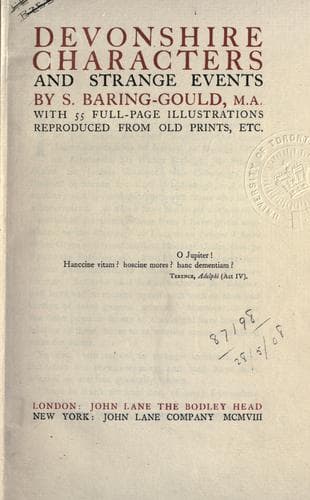
Devonshire Characters and Strange EventsBaring-Gould, S. (Sabine)
History
Devonshire Characters and Strange Events
Baring-Gould, S. (Sabine)
Devon (England) -- Biography; Devon (England) -- History
The prosecution on the part of the Crown lasted two days, and on the
26th, Parker called witnesses in his favour, and read a long and able
defence which he had previously prepared. The line of argument adopted
by him was--that the situation he had held had been in a measure
forced upon him; that he had consented to assume it chiefly from the
hope of restraining the men from excesses; that he had restrained them
in various instances; that he might have taken all the ships to sea,
or to an enemy’s port, had his motives been disloyal, etc. Parker
unquestionably spoke the truth on many of these points. Throughout the
whole affair, the injury done to property was trifling, the taking of
some flour from a vessel being the chief act of the kind. But he had
indubitably been the head of the mutineers. It was proved that he went
from ship to ship giving orders and encouraging the men to stand out,
and that his orders were given as though he were actually admiral of
the fleet. Nothing could save him. He was sentenced to death. When his
doom was pronounced, he rose, and said, in firm tones, “I shall submit
to your sentence with all due respect, being confident in the innocency
of my intentions, and that God will receive me unto His favour;
and I sincerely hope that my death will be the means of restoring
tranquillity to the Navy, and that those men who have been implicated
in the business may be reinstated in their former situations, and again
be serviceable to their country.”
On the morning of the 30th of June, the yellow flag, the signal of
death, was hoisted on board the _Sandwich_, where Richard Parker lay,
and where he was to meet his fate. The whole fleet was ranged a little
below Sheerness, in sight of the _Sandwich_, and the crew of every ship
was piped to the forecastle. Parker was awakened from a sound sleep
on that morning, and after being shaved, he dressed himself in a suit
of deep mourning. He mentioned to his attendants that he had made a
will, leaving to his wife some property in Devonshire that belonged to
him. On coming to the deck, he was pale, but perfectly composed, and
drank a glass of wine “to the salvation of his soul, and forgiveness of
all his enemies!” He said nothing to his mates on the forecastle but
“Good-bye to you!” and expressed a hope that “his death would be deemed
sufficient atonement, and save the lives of others.”
He was strung up to the yard-arm at half-past nine o’clock. A dead
silence reigned among the crews around during the execution. When cold,
his body was taken down, put in a shell, and interred within an hour
or two after his death in the new naval burying ground at Sheerness. A
remarkable and pathetic sequel to the account has served as the basis
of a popular ballad still sung.
Public-domain text, read in full here on John Shaqi.
Reviews
Reviews
No reviews yet
Be the first to share your thoughts on this work.
Elsewhere in the archive
Join the Discussion
Join the discussion
Sign in to leave a comment or review.
Sign InorCreate an account