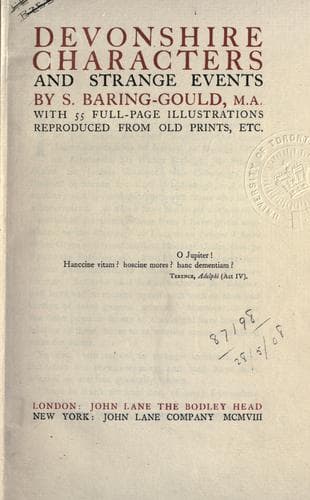
Devonshire Characters and Strange EventsBaring-Gould, S. (Sabine)
History
Devonshire Characters and Strange Events
Baring-Gould, S. (Sabine)
Devon (England) -- Biography; Devon (England) -- History
On the 4th June, the King’s birthday, the Nore fleet showed that their
loyalty to their Sovereign was undisturbed by firing a general salute.
On the 6th June two more ships deserted under the fire of the whole
fleet, but the same evening four more arrived from Admiral Duncan’s
fleet. On this day Lord Northesk, having been summoned on board the
_Sandwich_, found the council, comprising sixty delegates, sitting in
the state cabin, with Parker at its head. After receiving a letter
containing proposals of accommodation to which the unfortunate Parker
still put his name as president, Lord Northesk left, charged to deliver
this letter to the King. The answer was a refusal to all concessions
till the mutineers had surrendered unconditionally. Disunion thereupon
became more accentuated, and on 10 June, Parker was compelled to shift
his flag to the _Montague_ and the council removed with him.
On the same day the merchantmen were permitted by common consent to
pass up the river, and such a multitude of ships certainly had never
before entered a port by one tide.
Fresh desertions now occurred every day, and all hope of concerted
action was ended by stormy discussions, in which contradictory
suggestions were made with such heat as to lead in many instances to
acts of violence. Upon ship after ship the red flag was hauled down and
replaced by one that was white, signifying submission. On the 12th only
seven ships had the red flag flying. Such was the confusion, every crew
being divided into two hostile parties, that five ships were taken up
the Thames by those in favour of surrender, aided by their opponents
under the belief that an attack was about to be made on the shore
defences. The discovery by the latter that they were betrayed aroused
terrible strife. The deck of the _Iris_ frigate became a battlefield;
one party in the fore, the others in the after-part, turned the great
guns against each other, and fought till the mutineers were worsted.
By the 16th the mutiny had terminated, every ship having been restored
to the command of its officers. A party of soldiers went on board the
_Sandwich_ to which Parker had returned, and to them the officers
surrendered the delegates of the ship, namely a man named Davies and
Richard Parker.
Richard Parker, to whom the title of admiral had been accorded by
the fleet and by the public during the whole of this affair, was the
undoubted ringleader, and was the individual on whom all eyes were
turned as the chief of the mutineers. He was brought to trial on the
22nd of June, after having been confined during the interval in the
Black-hole of Sheerness garrison. Ten officers, under the presidency
of Vice-Admiral Sir Thomas Pasley, Bart., composed the court-martial,
which sat on board the _Neptune_, off Greenhithe. The prisoner
conducted his own defence, exhibiting great presence of mind, and
preserving a respectful and manly deference throughout towards his
judges.
Public-domain text, read in full here on John Shaqi.
Reviews
Reviews
No reviews yet
Be the first to share your thoughts on this work.
Elsewhere in the archive
Join the Discussion
Join the discussion
Sign in to leave a comment or review.
Sign InorCreate an account