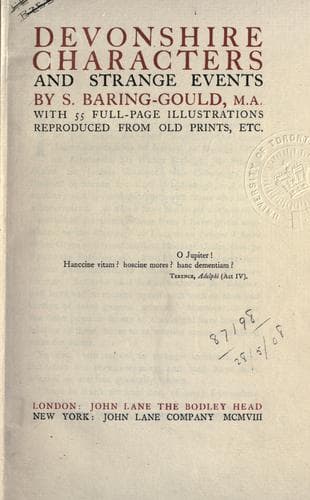
Devonshire Characters and Strange EventsBaring-Gould, S. (Sabine)
History
Devonshire Characters and Strange Events
Baring-Gould, S. (Sabine)
Devon (England) -- Biography; Devon (England) -- History
The Lord Mayor heard of the affair, and came to ask the widow what she
intended to do with her husband’s remains. She replied, “To inter them
decently at Exeter or in Scotland.” The Lord Mayor assured her that the
body would not be taken from her, and eventually prevailed on her to
consent to its being decently buried in London. Arrangements were made
with this view, and in the interim it was taken to Aldgate Workhouse,
on account of the crowds attracted by it, which caused some fears lest
“Admiral Parker’s remains should provoke a civil war.”
Finally, the corpse was buried in Whitechapel Churchyard, and Mrs.
Parker, who had in person seen her husband consigned to the grave, gave
a certificate that all had been done to her satisfaction. But, though
strictly questioned as to her accomplices in the exhuming and carrying
away of the body, she firmly refused to disclose the names.
Parker had, as he said, made a will, leaving to his wife the little
property he had near Exeter. This she enjoyed for a number of years,
but ultimately lost it through a lawsuit with Parker’s sisters,
who claimed that it was theirs by right. She was thrown into great
distress, and, becoming almost blind, was obliged to solicit assistance
from the charitable. King William IV gave her at one time £10, and at
another £20.
In 1836 the forlorn and miserable condition of poor Parker’s widow
was made known to the London magistrates, and a temporary refuge was
provided for her. But temporary assistance was of little avail to one
whose physical infirmities rendered her incapable of any longer helping
herself. When Camden Pelham wrote in 1840, she was aged seventy, blind,
and friendless; but time and affliction had not quenched her affection
for the partner of her early days. However, in 1828, John C. Parker,
the son of the mutineer, obtained a verdict against his aunts for the
possession of the little estate of Shute that had belonged to his
father’s elder brother. The question turned on the legitimacy of the
plaintiff, which was proved by his mother, a woman who then exhibited
the remains of uncommon beauty, and who was able to prove that she had
married Richard Parker in 1793.
Then farewell, Parker, best beloved,
That was once the Navy’s pride,
And since we might not die together,
We separate henceforth abide.
His sorrows now are past and over,
Now he resteth free from pain--
Grant, O God, his soul may enter
Where one day we meet again.[16]
The melody to which the ballad of the “Death of Parker” is set is much
more ancient, by two centuries at the least, than the ballad itself. It
is plaintive and very beautiful, and the words are admirably fitted to
the dainty and tender air.
Public-domain text, read in full here on John Shaqi.
Reviews
Reviews
No reviews yet
Be the first to share your thoughts on this work.
Elsewhere in the archive
Join the Discussion
Join the discussion
Sign in to leave a comment or review.
Sign InorCreate an account