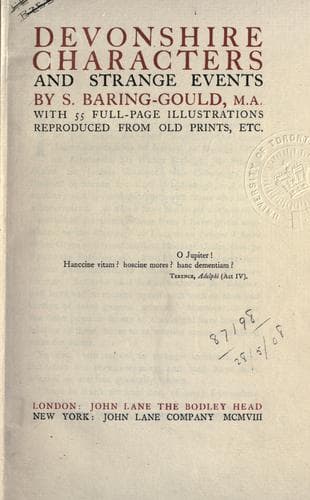
Devonshire Characters and Strange EventsBaring-Gould, S. (Sabine)
History
Devonshire Characters and Strange Events
Baring-Gould, S. (Sabine)
Devon (England) -- Biography; Devon (England) -- History
Richard Parker was a remarkably fine man. The brilliancy and expression
of his eyes were of such a nature as caused one of the witnesses, while
under examination, to break down, and quail beneath his glance, and
shrink abashed, incapacitated from giving further testimony.
Douglas Jerrold wrote a drama upon the theme of the “Mutiny at the
Nore.” But it is a mere travesty of history. The true pathos and beauty
of the story of the devoted wife were completely put aside for vulgar
melodramatic incidents.
For authorities, the _Annual Register_ for 1797; _The Chronicles of
Crime_, by Camden Pelham, London, 1840; _The Mutiny at Spithead and the
Nore_, London, 1842; “Richard Parker, of Exeter, and the Mutiny of the
Nore,” by S. T. Whiteford, in _Notes and Gleanings_, Exeter, 1888.
BENJAMIN KENNICOTT, D.D.
Benjamin Kennicott was born at Totnes on 4 April, 1718, and was the
son of Benjamin Kennicott, the parish clerk of that town. The family
had been one of some respectability, as in 1606 one Gabriel Kennicott
was mayor of Totnes. Probably, if a well-to-do tradesman family at one
time, it had sunk, and Benjamin senior was quite content to act as
clerk on a small stipend. His son was educated at the Grammar School,
founded by King Edward VI in 1554, and held in a building adjoining the
Guildhall, both of which occupy a portion of the old dissolved priory
of Totnes, on the north side of the church. The trustees of Eliseus
Hele had endowed the school, and the corporation were empowered to send
three boys to the school to receive their education free of expense;
and there can be little doubt that Benjamin the younger was one so
privileged. After quitting school he was appointed master of a charity
school for poor children, male and female, at Totnes; which same
charity children were provided with quaint and antiquated garbs. Young
Kennicott now doubtless thought that he was provided for for life.
In 1732, when he was only fourteen years of age, the bells of Totnes
tower were recast, and at the same time the ringers presented to the
bell-ringing chamber an eight-light brass candlestick inscribed with
the names of the ringers. Benjamin Kennicott the elder headed the
list, and Benjamin Kennicott the younger brought up the tail. But in
1742, when new regulations were drawn up and agreed to by the ringers,
the youngest ringer had become the leader.
Public-domain text, read in full here on John Shaqi.
Reviews
Reviews
No reviews yet
Be the first to share your thoughts on this work.
Elsewhere in the archive
Join the Discussion
Join the discussion
Sign in to leave a comment or review.
Sign InorCreate an account