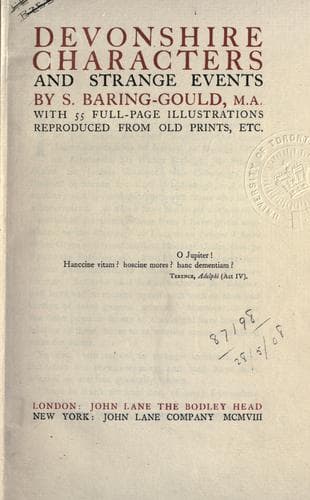
Devonshire Characters and Strange EventsBaring-Gould, S. (Sabine)
History
Devonshire Characters and Strange Events
Baring-Gould, S. (Sabine)
Devon (England) -- Biography; Devon (England) -- History
On this song the late Rev. H. H. Sheppard remarked: “There is an
indolent easy grace about this tune which is quite in keeping with the
words and charmingly suggestive. The sunny valleys, the breezy downs,
the sweet bell-music swelling and sinking on the soft autumn air,
the old folk creeping out of their chimney-nooks to listen, and all
employment in the little town suspended in the popular excitement at
the contest for the hat laced with gold; all this, told in a few words
and illustrated by a few notes, quite calls up a picture of life, and
stamps the number as a genuine folk-song. The narrator is unhappily
slightly intoxicated, but no one thinks the worse of him; stern
morality on that or any other score will in vain be looked for in songs
of the West.”
Such a picture as this must have occurred again and yet again in young
Kennicott’s life whilst head of the ringers at Totnes.
Kennicott’s sister was in service as lady’s-maid to the Hon. Mrs.
Elizabeth Courtney, of Painsford in Ashprington, near Totnes; and
in 1743 that lady had a narrow escape from death, having eaten a
poisonous herb in mistake for watercress, which it much resembled.
The charity-school master, on hearing of this, composed a poem on her
recovery, which he dedicated to “Kelland Courtney, Esq., and his Lady.”
It consisted of no fewer than three hundred and thirty-four lines;
and this effusion having gained him the favour of the family, he was
taken in hand, and sent in 1744 to Oxford, where he became a student of
Wadham College. But the Courtneys, though his principal patrons, were
not the sole. Archdeacon Baker, the Rev. F. Champernowne, and H. Fownes
Luttrell, Esq., subscribed to send him to college.
At Oxford he speedily attracted attention by his industry and
abilities, and was elected Fellow of Exeter College in 1747, and was
admitted to his B.A. degree a year before the usual time. He took
his M.A. degree in 1750, about which time he entertained a design of
collating the Hebrew texts of the Old Testament. In 1753 he published
his first volume on the state of the printed text, and in 1760 his
second volume. In these works he pointed out various discrepancies, and
proposed an extensive collation of manuscripts.
Subscriptions were obtained, and between 1760 and 1769 no less than
£9117. 7s. 6d. had been raised for the work. This work occupied ten
years. To aid in it, persons were employed to examine the MSS. in all
parts of Europe. In 1769, Dr. Kennicott stated that of the 500 Hebrew
MSS. then in Europe he had himself seen and studied 250; and of the
16 MSS. of the Samaritan Pentateuch eight had been collated for him.
Subsequently other MSS. were heard of, and the collation extended in
all to 581 Hebrew and 16 Samaritan MSS.
In 1776 appeared the first fruit of all the labour, being the first
volume of his _Vetus Testamentum Hebraicum cum variis lectionibus_,
and the second appeared in 1780.
Public-domain text, read in full here on John Shaqi.
Reviews
Reviews
No reviews yet
Be the first to share your thoughts on this work.
Elsewhere in the archive
Join the Discussion
Join the discussion
Sign in to leave a comment or review.
Sign InorCreate an account