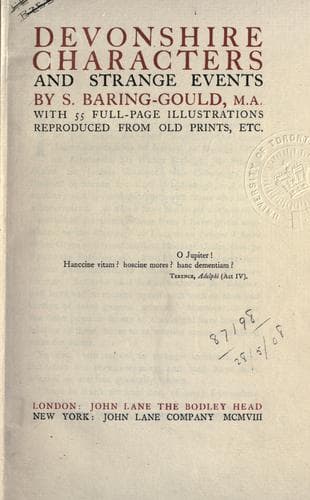
Devonshire Characters and Strange EventsBaring-Gould, S. (Sabine)
History
Devonshire Characters and Strange Events
Baring-Gould, S. (Sabine)
Devon (England) -- Biography; Devon (England) -- History
Kennicott took his degree of D.D. in 1761, and received from the Crown
a pension of £200. In 1770 he was made Prebendary of Westminster, but
this he afterwards exchanged for a canonry at Christchurch. He was
also rector of Culham, a valuable living, but resigned it, as owing to
his studies he was unable to reside and pay attention to his pastoral
duties there.
Against the garden wall of Exeter College grew a fig tree, and
Kennicott was very partial to figs. Now in a certain year there was
but a single fig on the tree. The Doctor watched it, eagerly expecting
when it would be ripe, for a fig is like a pear, it ripens and reaches
perfection all at once, before which moment it is no good at all. To
secure this fruit for himself he wrote out a label, “Dr. Kennicott’s
Fig,” and hung it above the fruit on the tree. But just as the fig was
fit to be gathered and eaten, some audacious undergraduate managed
to get it, plucked, ate, and then reversing the label wrote in large
letters thereon “A Fig for Dr. Kennicott.”
When the reverend divine was at the height of his fame he visited
Totnes, and was asked to preach in the parish church. This he consented
to do. In the vestry he found his old father, still parish clerk,
prepared to robe him. The Doctor protested. No--on no account would he
suffer that. He could perfectly well and unassisted encase himself in
cassock and surplice and assume his scarlet doctorial hood. But the old
man was stubborn. “But, Ben--I mean Reverend Doctor--do it I must, and
do it I will. You know, Ben--I mean Reverend Sir--I am your father and
you must obey.” So the Hebrew scholar was fain to submit and give to
the old parish clerk the proudest hour of his life. Dr. Kennicott died
on 18 September, 1783, in the sixty-sixth year of his age.
For authority see an article on “Benjamin Kennicott, /D.D./,” by
Mr. Ed. Windeatt, in the _Transactions_ of the Devonshire Association,
1878.
The portrait given with this article is from one in Exeter College.
CAPTAIN JOHN AVERY
Concerning this captain it is not easy to give a trustworthy account as
the discrepancies between the narratives of his life and adventures are
considerable, and the means of discriminating between the true and the
fictitious are not available. He is a Flying Dutchman who appears in
weird and terrible scenes, and then vanishes into mist.
The authorities for his adventures, such as they are, are these:--
(_a_) _“The Life of Captain Avery” in Captain Charles Johnson’s
General History of the Robberies and Murders of Notorious Pyrates,
from 1717._ London, 1724.
(_b_) _The Life and Adventures of Captain John Avery._ I. Baker.
London, 1709.
(_c_) _The Famous Adventures of Captain John Avery of Plymouth._
Falkirk, 1809. Probably a reprint of an earlier Life.
(_d_) _The King of Pirates._ (Supposed to be by Daniel Defoe.)
London, 1720.
Public-domain text, read in full here on John Shaqi.
Reviews
Reviews
No reviews yet
Be the first to share your thoughts on this work.
Elsewhere in the archive
Join the Discussion
Join the discussion
Sign in to leave a comment or review.
Sign InorCreate an account