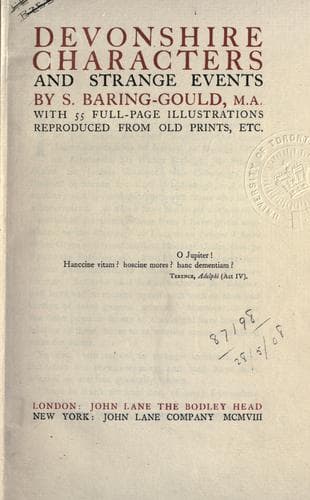
Devonshire Characters and Strange EventsBaring-Gould, S. (Sabine)
History
Devonshire Characters and Strange Events
Baring-Gould, S. (Sabine)
Devon (England) -- Biography; Devon (England) -- History
At this time much trouble and vexation to the East India Company was
caused by the interlopers. The Company had obtained their charter,
granting them exclusive rights to trade between India and England,
and they had certain determined ports where they had their factories.
But the trade was so profitable that companies of merchants and
private adventurers embarked on the trade in defiance of the rights
of the Company. They put into ports within the limits of the Company
concessions, but to which the ships of the latter did not resort, by
this means undermining and invading the rights of the Company. It
was more than that, it was a direct attack on the legal exercise of
the privileges of the Company. In 1695 the British Court informed
Sir John Gayer and the Presidency of Surat that the expedients which
had been adopted for suppressing the interlopers had failed at home
and abroad by their not being excluded from foreign markets, and the
Company’s servants were required to obstruct their sales in foreign
markets, and further to take measures against their entering the Indian
ports. In 1675-6, the interlopers being disappointed in the sales of
their cargoes and in the purchase of Indian produce, determined not
to return to Europe without realizing gains for themselves and their
employers, and they turned pirates and seized vessels belonging to the
native princes, and left the Company’s servants exposed to suspicion
and imprisonment and their property to seizure and confiscation. It
was precisely at this conjuncture that Avery’s little piratical fleet
made its capture. The vessel, the _Gunswek_, was bound from Bombay
for Daman. Avery cleared it of all its treasure, and only released
the pilgrims on payment of a heavy indemnity, and left the ship to be
steered back to Bombay by the native crew. As to the ladies on board,
Avery took to himself that one whom he supposed to be the daughter of
the Great Mogul, and let his crew toss up for the rest as partners.
John Bruce in his _Annals of the East India Company_ says nothing
of the retention of the ladies, nor of the capture of the Mogul’s
daughter. It is likely enough that some women were taken and retained,
but certainly no lady of so high a rank as the grand-daughter of
Aurungzebe.
Public-domain text, read in full here on John Shaqi.
Reviews
Reviews
No reviews yet
Be the first to share your thoughts on this work.
Elsewhere in the archive
Join the Discussion
Join the discussion
Sign in to leave a comment or review.
Sign InorCreate an account