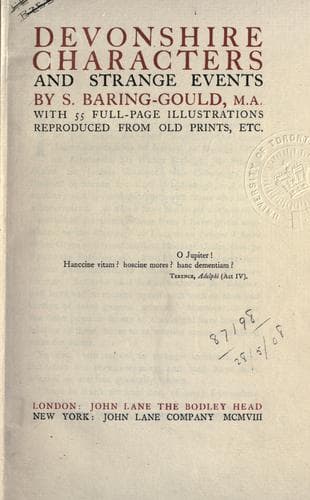
Devonshire Characters and Strange EventsBaring-Gould, S. (Sabine)
History
Devonshire Characters and Strange Events
Baring-Gould, S. (Sabine)
Devon (England) -- Biography; Devon (England) -- History
This outrage produced very unpleasant effects. Already in September,
1695, an interloping vessel turned pirate, and, bearing English
colours, had plundered a ship belonging to Abdul Gopher, a merchant
of Surat, and the governor of the place had been obliged to set a
guard on the house of the Company to prevent its being wrecked by the
enraged natives, and the servants of the Company from being massacred.
News now arrived that the same pirate had attacked a ship belonging
to the Mogul, conveying pilgrims to Mecca. If the first injury to an
individual merchant was resented, this which was deemed a sacrilege
roused fanatical resentment to fury, and obliged the Governor to put
the President and all the English in irons to prevent their being torn
to pieces by the inhabitants.
The Governor desired French, Dutch, and English to send vessels
in search of the pirate, that by her capture the fact might be
ascertained as to who really was responsible. The French and Dutch
hesitated to comply, and the readiness of the English to go on this
service served somewhat to abate the hostility entertained against them.
Sir John Gayer, as General of the Company’s affairs, wrote to the
Mogul to assure him that the Company were not only ignorant of the
existence of such a pirate, but were ready to employ two of their ships
completely armed to convey the pilgrims to Jedda, if he would grant
that all the English but the Company should be debarred from trading in
his dominions. The Mogul answered “that the English, French, and Dutch
must go to sea in search of the thieves, but that the embargo he had
placed on all trade must continue till the innocence or guilt of the
English Company was proved.”
Mr. Bruce does not name John Avery as the pirate, but this must be the
case spoken of in his Life. It will be noticed that the dates do not
accord. The capture of the pilgrim vessel took place in the winter of
1693-4, and, according to Johnson, it was not till after the Peace of
Ryswick, 10 September, 1697, that Avery made the capture, and it was in
consequence of this treaty that he was able to get hold of the vessels.
From the date 1693 the pilgrims were annually conveyed to Jedda by
ships of the Company, so that Avery could not have captured one of them
after that date. Charles Johnson must have blundered in his facts.
The sum demanded by Avery for the release of the pilgrims was three
hundred thousand pounds, and he got it.
He had already established himself at Perim, and levied toll on all
vessels passing in and out of the Red Sea, but after this affair,
when large rewards were offered by the Company and by the British
Government for his capture, he deemed it advisable to change his
quarters and establish himself in Madagascar.
Public-domain text, read in full here on John Shaqi.
Reviews
Reviews
No reviews yet
Be the first to share your thoughts on this work.
Elsewhere in the archive
Join the Discussion
Join the discussion
Sign in to leave a comment or review.
Sign InorCreate an account