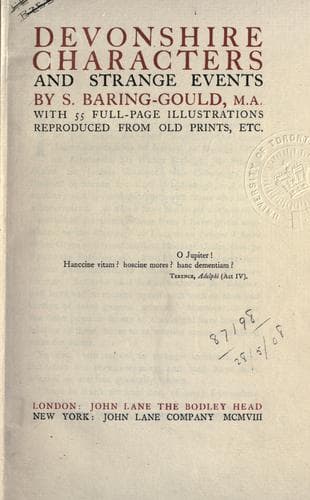
Devonshire Characters and Strange EventsBaring-Gould, S. (Sabine)
History
Devonshire Characters and Strange Events
Baring-Gould, S. (Sabine)
Devon (England) -- Biography; Devon (England) -- History
In the year 1829 Mr. Warburton introduced a Bill into the House of
Commons for the prevention of the unlawful disinterment of human bodies
and for the regulation of schools of anatomy. The horrible revelations
of the murders--at least thirty--committed by Burke and Hare, in
Edinburgh, for the sake of providing subjects for the purposes of
anatomy to lecture on, had produced a profound emotion. The Bill passed
the House of Commons, but was thrown out by the Lords.
So long as the European war continued, the period of time required
for the completion of the education of medical students, so as to fit
them for the service in the Army or Navy, was unduly short, and the
study of anatomy was consequently much neglected. At that time the
dissecting-rooms were supplied by men who in general exhumed bodies.
The trade was lucrative; one resurrectionist at his death left nearly
£6000 to his family. Another resurrectionist, after a long career,
withdrew in 1817. He had attended the army in the Peninsula and in
France as a licensed sutler, and after a battle went over the field
extracting the teeth of those who had fallen and such as were dying,
and disposed of them to dentists in England. With the produce of these
sales he built a large hotel at Margate. A leading resurrectionist once
received £144 for twelve subjects in one evening. Sir Astley Cooper
expended hundreds of pounds in the purchase of bodies and in advancing
money to screen these useful auxiliaries of the anatomical school. To
obtain the liberation of one he paid £160.
The proper education of a surgeon demanded that he should be acquainted
with anatomy, and the only provision made by the legislature was that
the bodies of criminals who had been executed should be handed over
to the schools. This did not furnish by any means an adequate number,
and the professors of anatomy were obliged to have recourse to the
professional purveyor of corpses, knowing well enough, or suspecting,
whence they came.
A select committee of the House of Commons was appointed to inquire
into the matter, and several of the profession were had up for
examination.
Here is the evidence of one resurrectionist, condensed:--
“A man may make a good living at it if he is a sober man, and acts
with judgment. I should suppose there are at present in London between
forty and fifty men that have the name of raising subjects. If you are
friends with a grave-digger, the thing will be all right to know what
bodies to get; if you are not, you cannot get them. The largest number
of bodies I have got were twenty-three in four nights. It was only in
one year that I got one hundred. Perhaps the next year I did not get
above fifty or sixty. When I go to work I like to get those of poor
people buried from the workhouses, because, instead of working for one
subject, you may get three or four. I do not think, during the time I
have been in the habit of working for the schools, I got half a dozen
of wealthier people.”
Public-domain text, read in full here on John Shaqi.
Reviews
Reviews
No reviews yet
Be the first to share your thoughts on this work.
Elsewhere in the archive
Join the Discussion
Join the discussion
Sign in to leave a comment or review.
Sign InorCreate an account