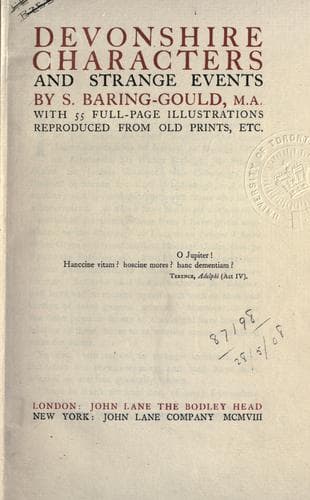
Devonshire Characters and Strange EventsBaring-Gould, S. (Sabine)
History
Devonshire Characters and Strange Events
Baring-Gould, S. (Sabine)
Devon (England) -- Biography; Devon (England) -- History
A second said: “The course I should take would be to have the
workhouse subjects; we can get them out of the burial-ground without
any difficulty whatever.”
One of the largest dealers was Israel Cohen, commonly called Izzy,
a Jew, well known to surgeons and sextons. By the surgeons he was
patronized; of the sextons he was the patron; and so complete was
the understanding between the profession to which he belonged and
those with which he was connected, that the interest of all three was
advanced by coalition. He was a square-built, resolute ruffian, with
features indicative of his Hebrew origin, black whiskers, and a squint.
The Plymouth medical men memorialized the Government in 1827 relating
to the necessity they were in of having human bodies for dissection,
and the inadequacy of the legitimate supply. “In other countries,” they
said, “the dissection of the dead, so necessary to the well-being of
the living, is permitted and protected; and is actually prosecuted,
without shocking any existing prejudice or violating the sanctities of
the dead. It follows either that the professional gentlemen of this
kingdom must be contented with a very inferior medical education, or
that they must resort to the Continent to obtain that information which
is denied to them by the laws of Great Britain.” The alternative of
having recourse to resurrectionists they did not refer to. The memorial
produced no results.
In the recent alterations of Princetown Church, it was found that no
inconsiderable number of the graves of the French prisoners who died
during incarceration were empty. There can be little doubt that the
bodies were disposed of to the surgeons in Plymouth. It was generally
supposed that the body-snatchers in exhuming a corpse first proceeded,
as would a novice, in excavating the whole grave, and having arrived
at the coffin would then force off the lid and so get possession of
the body. But this would have been too slow an operation. To do the job
expeditiously they cleared away the earth above the head of the coffin
only, taking care to leave that which covered the rest of the coffin
undisturbed. As soon as about one-third of the chest was thus exposed,
they forced a very strong crowbar between the end of the coffin and the
lid, and easily prised it open. It usually happened at this stage of
the proceedings that the superincumbent weight of earth on the other
portion of the coffin-lid caused it to be snapped across. As soon as
this was effected the body was drawn out, the death-gear removed from
it and replaced in the coffin, and finally the body was tied up in
a bundle or thrust into a sack and taken away, the whole operation
lasting not over a quarter of an hour.
Public-domain text, read in full here on John Shaqi.
Reviews
Reviews
No reviews yet
Be the first to share your thoughts on this work.
Elsewhere in the archive
Join the Discussion
Join the discussion
Sign in to leave a comment or review.
Sign InorCreate an account