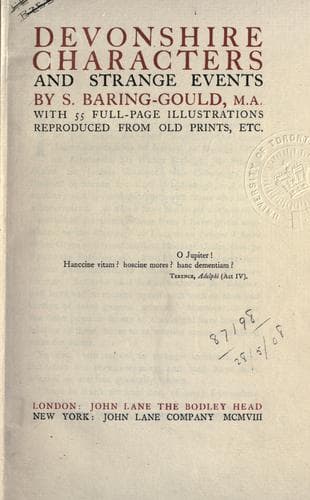
Devonshire Characters and Strange EventsBaring-Gould, S. (Sabine)
History
Devonshire Characters and Strange Events
Baring-Gould, S. (Sabine)
Devon (England) -- Biography; Devon (England) -- History
Very generally a hackney coach or a spring cart was in waiting to
receive the body. When corpses were sent from the country to London
they were generally packed in barrels or hat-crates. But when one was
to be taken to a dissecting-room in the same town it was laid on a
large piece of green baize, the four corners were tied together, and
so the body was rolled up in a bundle. The body-snatcher would then,
dressed as a porter, swing the load over his shoulder, and often, even
in broad daylight, carry it to its place of destination through the
most crowded streets.
Every means which ingenuity could suggest was put in practice to obtain
bodies which had not been buried. For this purpose the men, when they
heard of the body of a person being found--drowned, for instance, and
lying to be owned--trumped up a story of an unfortunate brother or
sister, humbugged a coroner’s jury, and thus obtained possession of
the body. In this sort of trickery the wives of the men were often
employed, as their application was attended to with less suspicion,
and it was never difficult to impose on the parochial officials, who
were always anxious to avoid the expense of burying the deceased.
Subjects were thus occasionally procured, but they were more frequently
obtained by pretending relationship to persons dying without friends in
hospitals and workhouses. As the bodies thus obtained were much fresher
than those which had been buried, they produced generally, independent
of the teeth, as much as twelve guineas each.
At the commencement of a new term at the hospitals, the lecturers on
anatomy were beset by the leading dealers in subjects, and “fifty
pounds down, and nine guineas a body,” was often acceded to. The larger
sum down secured to the lecturer the exclusive supply of that dealer’s
wares. The competition for subjects was great, and in some cases twenty
pounds were paid for a single corpse in good condition.
Stoke Church and yard lay solitary amid waste land. It had a wall round
it, but no houses very near, and there were no oil lamps burning in the
road that passed it.
Public-domain text, read in full here on John Shaqi.
Reviews
Reviews
No reviews yet
Be the first to share your thoughts on this work.
Elsewhere in the archive
Join the Discussion
Join the discussion
Sign in to leave a comment or review.
Sign InorCreate an account