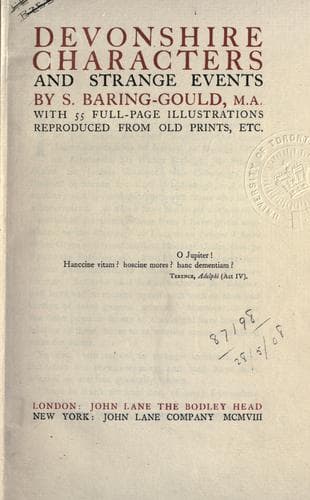
Devonshire Characters and Strange EventsBaring-Gould, S. (Sabine)
History
Devonshire Characters and Strange Events
Baring-Gould, S. (Sabine)
Devon (England) -- Biography; Devon (England) -- History
The plot of the piece was thin and poor, but the people were refreshed,
and rejoiced to hear again the old familiar notes of English music.
There were sixty-nine airs in _The Beggars’ Opera_, and nearly every
one was an old English ballad or song air. Gay was not himself a
musician, but he had his head full of old ballads and their airs,
most, doubtless, picked up about Barnstaple or Bideford, and he set
to the tunes words suitable to his characters and the dialogue, and
then got a German named Pepusch to note them down for him and write a
simple orchestral accompaniment and an overture. The author, according
to Mace, got the entire receipts of four nights, amounting in the
aggregate to £693 13s. 6d., whereas Rich, the manager, after the piece
had been performed thirty-six times, had pocketed nearly £4000. It was
well said that this play made Rich _gay_, and Gay _rich_.
Lavinia Fenton had been tempted by Rich from the Haymarket to Lincoln’s
Inn Fields to act the part of Polly in _The Beggars’ Opera_ at a salary
of 15s. per week, but owing to the enormous success of the play he
raised it to 30s.; and such was the rage of the town respecting her
that she was obliged to be guarded home every night by a considerable
party of her confidential friends, to prevent her being hurt by the
crowd or being run away with. The Duke of Bolton became enamoured of
her--took her under his protection, as the euphemism went. The Duke
was then in the prime of life, living apart from his wife. “Polly” was
not remarkably pretty, but she had a charming manner and a delicious
voice. Wharton tells us that he knew her, and could testify to her
wit, intelligence, and good manners. “Her conversation,” says he, “was
admired by the first characters of the age, particularly the old Lord
Bathurst and Lord Grenville.” She and the Duke had several quarrels,
and after one very serious explosion he gave her notice to quit the
house.
She retired to her room, assumed the costume of Polly Peachum,
returned, and presenting herself before him in all the grace and charm
with which she had first won him, with tears in her eyes, sang--
Oh, what pain it is to part!
Can I leave thee? Can I leave thee?
Oh, what pain it is to part!
Can thy Polly ever leave thee?
to the air “Gin thou wert mine ain thing,” to which it had been set by
Gay.
Touched by the remembrance of the past and by her witchery of
manner, the Duke opened his arms, she flew to his heart, and the
reconciliation was complete. On the death of the Duchess, the Duke
married Lavinia Fenton at Aix in Provence, 21 October, 1751, just
one day beyond the month after the death of his wife, who died on 20
September.
The children borne by “Polly” to the Duke before the marriage were
three sons, who all assumed the name of Powlett. The Duke died on 26
August, 1754, and was succeeded in the dukedom by his brother. “Polly”
Fenton died at West Combe Park, Kent, on 24 January, 1760, at the age
of fifty-two.
Public-domain text, read in full here on John Shaqi.
Reviews
Reviews
No reviews yet
Be the first to share your thoughts on this work.
Elsewhere in the archive
Join the Discussion
Join the discussion
Sign in to leave a comment or review.
Sign InorCreate an account