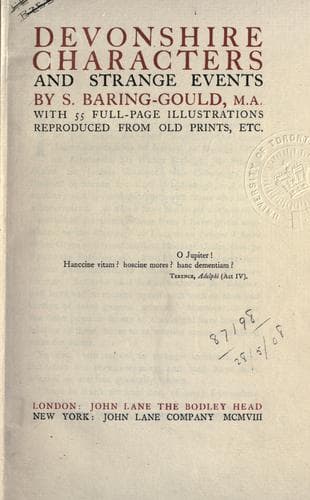
Devonshire Characters and Strange EventsBaring-Gould, S. (Sabine)
History
Devonshire Characters and Strange Events
Baring-Gould, S. (Sabine)
Devon (England) -- Biography; Devon (England) -- History
Assuredly never was a more sudden, complete, and unexpected success
achieved than that by the production of _The Beggars’ Opera_. It defied
the prevailing taste; it went contrary to all the received canons
of art, it was as audacious as a play as it was musically. Hitherto
the Opera had been in the hands of Italians. The themes selected for
musical setting had been classic and mythological. Then came Gay,
taking his subject from the lowest class--gaol-birds; and discarding
all intricate and foreign music, set his songs to melodies familiar to
all from their cradles.
It was said of the deserted stalls and boxes at the Italian Opera
whilst Gay’s piece held the town, that he had made of the Italian the
veritable Beggars’ Opera.
Sir Robert Walpole was frequently the subject of Gay’s satire.
Nevertheless he attended the first performance, and sat in one of the
stage lounges. When Lockit sang--
When you censure the age,
Be cautious and sage,
Lest the courtiers offended should be.
If you mention _vice_ or _bribe_,
’Tis so pat to all the tribe,
That each cries--That was levelled at me!
Sir Robert observing that all eyes turned upon him at these lines,
parried the thrust by leading the applause. After an uninterrupted run
in London of sixty-three nights, and emptying the Italian Opera House,
the play spread into all the great towns of England, and was played in
many places thirty or forty times--in Bath and Bristol fifty times. It
made its progress into Wales, where it contributed some of its airs to
national Welsh melody, to Scotland and Ireland; and last of all it was
performed in Minorca.
Nor was its fame confined to the reading and representation alone, for
the card-table and the drawing-room shared with the theatre and the
closet in this respect; the ladies carried about the favourite songs
engraven on their fans, and screens were decorated with scenes from the
play.
Hogarth’s painting representing the first scene on the boards, with
noble dukes and earls on fauteuils upon the stage, is well known. His
portrait of Polly Fenton is in the National Gallery.
Public-domain text, read in full here on John Shaqi.
Reviews
Reviews
No reviews yet
Be the first to share your thoughts on this work.
Elsewhere in the archive
Join the Discussion
Join the discussion
Sign in to leave a comment or review.
Sign InorCreate an account