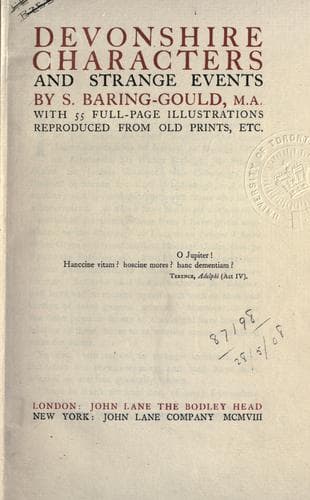
Devonshire Characters and Strange EventsBaring-Gould, S. (Sabine)
History
Devonshire Characters and Strange Events
Baring-Gould, S. (Sabine)
Devon (England) -- Biography; Devon (England) -- History
_The Beggars’ Opera_ was revived by Messrs. Gatti at Covent Garden
in the season 1878-9. On this occasion wrote _Punch_: “The house
was literally crammed from floor to ceiling by an audience whose
enthusiastic temperature increased in a graduated thermometrical scale,
the over-boiling point being reached at the back row of the upper
gallery; and this on a night when, in the stalls and boxes, wrappers,
furs, mantles, and ulsters were _de rigueur_ on account of the rigour
of the cold.... Let those who do not believe in a comic tenor see Sims
Reeves as Captain Macheath, and they will discover what magic there
is even in a refrain of ‘tol-de-lol, lol-de-rol, loddy,’ when given
by a tenor who is not impressed by the absurd traditional notion that
he is nothing if not sentimental. His acting of the celebrated song
‘How happy could I be with either’ is full of humour, and his change
of manner from ‘tol-de-rol’ in a tender tone, when addressed to the
gentle, confiding Polly, to the ‘tol-de-rol’ with a true Cockney
chick-a-leary twang when addressed to the vulgar Lucy Lockit, is a
clever idea, most artistically carried out; and then his dance up the
stage while singing, giving his last note good and true to the end in
spite of his unaccustomed exertion, as with a jump he seats himself
in a natural devil-may-care style upon the table, was followed by an
_encore_ so momentous that even he, the _anti-encorist_, was fain to
comply with the enthusiastic demand; so he repeated the two verses, the
dance, and the jump with as much freshness and vigour as though he had
not already sung six songs--snatches, more or less, it is true--and had
got ten more to follow.”
As a man, Gay was amiable and winning in manner. He had a
foible--indolence. Nevertheless he had saved several thousand pounds
at the time of his death, which occurred in the house of the Duke and
Duchess of Queensberry, in Burlington Gardens, in December, 1732, and
he was buried in Westminster Abbey.
And now, having done with the man, we come to his chair.
Rather over eighty years after the death of Gay some unpublished
poems of his were found in an old arm-chair which had belonged to the
poet, and after his death had been retained, with other relics, by
the surviving members of his family. The history was fully narrated
immediately after the discovery in a little book, called _Gay’s
Chair_, along with the life of the poet and a selection of the poems
discovered; some were too broad in humour for publication.
Public-domain text, read in full here on John Shaqi.
Reviews
Reviews
No reviews yet
Be the first to share your thoughts on this work.
Elsewhere in the archive
Join the Discussion
Join the discussion
Sign in to leave a comment or review.
Sign InorCreate an account