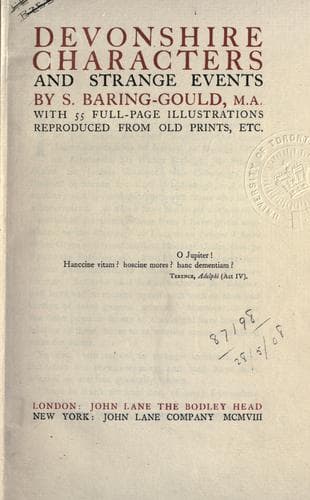
Devonshire Characters and Strange EventsBaring-Gould, S. (Sabine)
History
Devonshire Characters and Strange Events
Baring-Gould, S. (Sabine)
Devon (England) -- Biography; Devon (England) -- History
Edward Gifford returned from sea in 1764, having been absent eight
years. He had received over a hundred pounds of prize money in
addition to his wages, which were considerable; but as he reappeared
in Ashburton his pockets were nearly empty. The little property yet
left was therefore turned into money, and Edward Gifford set up a
second time as glazier, plumber, and house-painter. William was now
sent to the free school in S. Laurence’s Chapel, the master of which
was Hugh Smerdon. This school was founded by Bishop Stapeldon in the
tower of the old Chantry Chapel. On the dissolution of the chantries,
the scholars and master moved out of the tower into the body of the
chapel. It was further endowed with funds by Edward Gould, Esq., of
Pridhamsleigh, and Mr. Peter Blundell, of Tiverton. In this school
William Gifford learned to read, write, and cypher. He remained there
till his father’s death three years later. Edward Gifford had learned
nothing by his misfortunes. He preferred to drain the pewter in the
tavern to doing pewterer’s work in the shop. He died and was buried 9
June, 1767, leaving beside a widow and his son William another son
aged six or eight months. Mrs. Gifford unwisely continued the business
without knowing anything about it, and committed the management to a
couple of journeymen, who wasted her property and embezzled her money.
In less than a twelvemonth she died, and was buried 29 November, 1768.
William was then thirteen and his brother not two years old; and they
had not a relation or friend in the world. Everything left was seized
by a man named Carlile for money advanced to Mrs. Gifford. The youngest
child was sent to an almshouse, and William was taken charge of by
Carlile, who was his godfather, not out of pity, but because he was
afraid of forfeiting the respect of his fellow citizens if he turned
the orphan adrift.
The life of the unfortunate youngest child was short. He was indeed
The child of misery, baptized in tears.
When aged seven the parish bound him apprentice to a farmer of the
name of Leman, with whom he endured incredible hardships, and at nine
broke his thigh. On his recovery he tried the sea, and went on board
the _Egmont_, but was allowed to do this by the grasping Leman, as his
apprenticeship was not expired, only on condition that his wages should
be paid into his (Leman’s) hands. The poor lad knew no favourable
change of fortune, for he fell sick and died at Cork.
Carlile sent the unfortunate William to drudge at the plough; but
William was physically incapable of driving the plough. During his
father’s life, in attempting to clamber up a table, he had fallen
backwards and drawn it after him; its edge fell on his chest, and it is
possible that his spine was also jarred, giving him ever after a look
of deformity. Ploughing was out of the question, and he was forced to
be withdrawn from field labour.
Public-domain text, read in full here on John Shaqi.
Reviews
Reviews
No reviews yet
Be the first to share your thoughts on this work.
Elsewhere in the archive
Join the Discussion
Join the discussion
Sign in to leave a comment or review.
Sign InorCreate an account