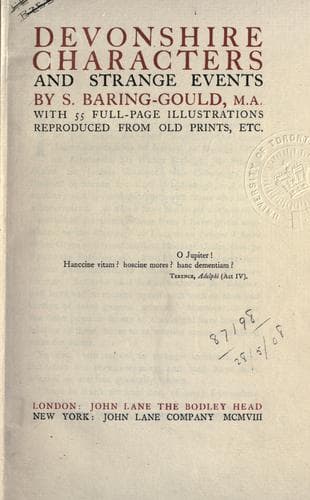
Devonshire Characters and Strange EventsBaring-Gould, S. (Sabine)
History
Devonshire Characters and Strange Events
Baring-Gould, S. (Sabine)
Devon (England) -- Biography; Devon (England) -- History
His guardian then thought of sending him to Newfoundland to assist in
a storehouse, and for this purpose entered into correspondence with
a Mr. Holdsworth, of Dartmouth, who consented to see the boy. When,
however, he had cast eyes on the puny, sickly child, he declined to
have anything to do with him, and Carlile then sent him on board a
coaster at Brixham, with a man named Full, plying between Dartmouth and
Plymouth, and sometimes going as far as Portsmouth.
In this boat he continued for a twelvemonth.
On Christmas Day, 1770, he was summoned back to Ashburton by his
godfather. It seemed that the fishwives who went from Brixham to
Ashburton with their wares had spoken there pretty freely of the little
ragged urchin who wandered about the quay, and of his delicacy and
of the rough treatment to which he was exposed. This roused a strong
feeling in Ashburton against Carlile, and he was constrained to bring
the boy back so as to allay the prejudice his conduct had awakened.
He sent him again to school in the old chapel, where he sat on the
benches at the long desks, and looked up at the huge plaster-work
gaily-painted shield and bearings of Ashburton over the headmaster’s
desk, and those of the benefactors to the school down the sides. Here
he worked assiduously at his books and made astonishing progress. He
was even employed as a monitor to teach the younger boys, and received
a few coppers for his services. The ambition of his young heart was to
qualify himself to take the place of the old schoolmaster, Smerdon, who
was becoming infirm and past work.
But these dreams of future happiness in the school where he had
passed his most enjoyable hours were dashed. Carlile wanted to get the
lad out of Ashburton and relieve his pocket of the burden of finding
him clothes and bread and butter. He was determined to wash his
hands of the orphan altogether; and accordingly, without consulting
the boy’s wishes, indentured him in January, 1772, to a cobbler, a
cousin of his in Exeter, with whom he would be bound to remain till
he was twenty-one. The shoemaker with whom he was placed was a sour
and narrow-minded Presbyterian, who read nothing but controversial
pamphlets relative to a theological dispute then raging between two of
the clergy of Exeter and some of the Dissenting preachers of the city,
and of these controversial pamphlets the cobbler read only those of his
own side.
Gifford had no books save a Bible, a Thomas à Kempis, and a
black-letter romance, _Parismus and Parismenus_, that had belonged
to his mother, together with some chapbooks, _The Golden Bull_, and
such like trifles. However, he found a stray treatise on algebra in
a lodging-house, and commandeered it. But this last book was not at
this time of any advantage to him, as to understand it a preliminary
knowledge of simple equations was necessary--and what “equations” meant
he knew no more than did the man in the moon, who had at his command no
library whatsoever.
Public-domain text, read in full here on John Shaqi.
Reviews
Reviews
No reviews yet
Be the first to share your thoughts on this work.
Elsewhere in the archive
Join the Discussion
Join the discussion
Sign in to leave a comment or review.
Sign InorCreate an account