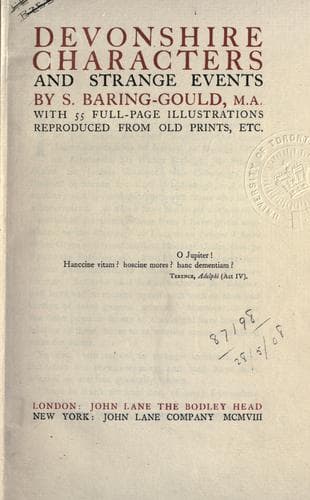
Devonshire Characters and Strange EventsBaring-Gould, S. (Sabine)
History
Devonshire Characters and Strange Events
Baring-Gould, S. (Sabine)
Devon (England) -- Biography; Devon (England) -- History
Mr. Cookesley’s active benevolence was cut short by his untimely death.
He did not live long enough to do more than start his young friend on
the road to fame and affluence. This event took place on 15 January,
1781. He died suddenly, and with a letter of Gifford’s unopened in his
hands. He left his family but scantily provided for, but a man’s good
works follow him, and the harvest comes sometime, if late, as we shall
see in the sequel.
In his _Autobiography_, written twenty years later, Gifford says: “It
afflicted me beyond measure, and in the interval I have wept a thousand
times at the recollection of his goodness; I yet cherish his memory
with filial respect; and at this distant period my heart sinks within
me at every repetition of his name.”
Gifford was, however, encouraged by the unexpected friendship of the
Rev. Servington Savery. He had, moreover, gained other friends, not
more kindly, but better able to serve him with their purses. His
acquaintance with his greatest patron, Earl Grosvenor, was made through
an accident. He had formed a college acquaintance with a young man
who kept up a correspondence with him, and to whom, when this latter
left college, he addressed his letters under cover to Lord Grosvenor.
But on one occasion he forgot to put his friend’s name to the letter,
and it was opened by the Earl, who read it, and was surprised at the
wit and brilliance of scholarship it evinced, and he begged for an
introduction. This led to his being sent as tutor to travel abroad
with Lord Belgrave, Earl Grosvenor’s son. Under the auspices of this
nobleman he entered upon London life, and gradually rose to an eminent
position among men of letters.
But there is an episode in his life to which he himself makes no
allusion in his memoirs. Somewhere about the time when he was able
to maintain himself, he married a certain Joanna--her surname is not
known--but not at Ashburton. It can hardly be doubted that this was
the “little girl down the lane” who had cheered him with her smile and
voice in his hours of deepest gloom.
The entry of this marriage has not yet been found, but it will be
lighted on some day in the register of one of the Exeter churches. To
her he often alluded in his poems, as Anna. In an ode to a tuft of
violets we find the following:--
Come then--ere yet the morning ray
Has drunk the dew that gems your crest,
And drawn your balmiest sweets away;
O come and grace my Anna’s breast.
O! I should think--that fragrant bed
Might I but hope with you to share--
Years of anxiety repaid
By one short hour of transport there.
To her he appears to have been deeply attached. He moved her to
Ashburton, and there visited her when he could escape from his literary
labours in London, and there she faded, and was buried on 27 December,
1789. Gifford was stricken by her loss in the most sensitive part
of the human heart, for over her grave he poured forth the pathetic
lament:--
Public-domain text, read in full here on John Shaqi.
Reviews
Reviews
No reviews yet
Be the first to share your thoughts on this work.
Elsewhere in the archive
Join the Discussion
Join the discussion
Sign in to leave a comment or review.
Sign InorCreate an account