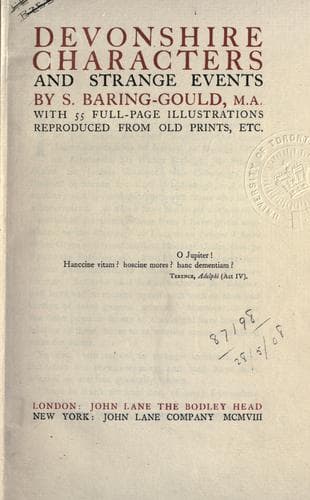
Devonshire Characters and Strange EventsBaring-Gould, S. (Sabine)
History
Devonshire Characters and Strange Events
Baring-Gould, S. (Sabine)
Devon (England) -- Biography; Devon (England) -- History
I wish I was where Anna lies,
For I am sick of lingering here,
And every hour affliction cries,
“Go, and partake her humble bier.”
I wish I could! For when she died
I lost my all; and life has proved
Since that sad hour a dreary void,
A waste, unloving and unloved.
Perhaps the surest testimony to the pain left in his soul by her loss
is his silence in his _Autobiography_ concerning her. She--and his love
and his sorrow--were too sacred to be brought before the public eye.
He never mentioned her, or that he had been married, even to his best
friends; and in Murray’s _Reminiscences_ it is asserted that Gifford
never was married.
In Lord Grosvenor’s house Gifford proceeded with his translation of
_Juvenal_, that had occupied him off and on for some years. His bitter
humour agreed with the biting sarcasm of the Roman poet, and the
work on which he was engaged was one of love. But, previous to its
publication, he hurled his _Baviad_ at the heads of the Della Cruscan
school of poetasters, in 1794. The name signifies “of the Bran,”
and was adopted by a literary coterie, to signify that their poetic
productions were sifted, and of the purest wheat. It was a mutual
admiration society, and was composed of Robert Merry, a fanatical
Republican, who had married Miss Brunton, the celebrated actress, and
sister of the still more celebrated Louisa, who became Countess of
Craven; another member of the society was Mrs. Piozzi; others were Mrs.
Robertson and Bertie Greathead. This set inundated the newspapers,
magazines, and annuals with a flood of weak and watery “poetry.”
As Byron says, addressing this set:--
With you I was not: Gifford’s heavy hand
Has crush’d, without remorse, your numerous band.
In 1795 appeared the _Mæviad_, a satire of the same class, in which,
although equally personal, there was less unnecessary virulence.
Following up a line of composition so congenial to his temper and
talents, he published, in 1800, his _Epistle to Peter Pindar_, of which
some lines are given in the article devoted to that abusive poet. This
roused Wolcot to fury, and he sought out and found the rival satirist
in the publisher’s shop.
An amusing account of the fray is given by Mr. Moonshine, “The Battle
of the Bards.” Sir Walter Scott says of it: “Though so little an
athlete, he nevertheless beat off Dr. Wolcot, when that celebrated
person, the most unsparing calumniator of his time, chose to be
offended with Gifford for satirizing him in his turn. Peter Pindar made
a most violent attack, but Gifford had the best of the affray, and
remained, I think, in triumphant possession of the field of action, and
of the assailant’s cane.”
Scott had a high opinion of Gifford as a poet in his peculiar line. He
wrote in 1805: “I have a good esteem of Mr. Gifford as a manly English
poet, very different from most of our modern versifiers.”
Public-domain text, read in full here on John Shaqi.
Reviews
Reviews
No reviews yet
Be the first to share your thoughts on this work.
Elsewhere in the archive
Join the Discussion
Join the discussion
Sign in to leave a comment or review.
Sign InorCreate an account