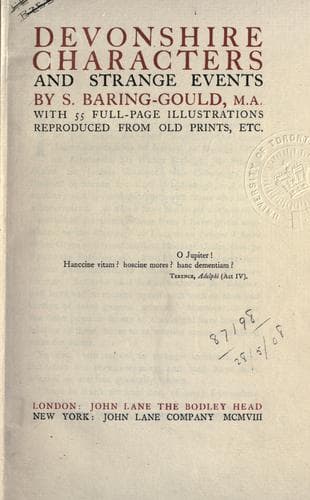
Devonshire Characters and Strange EventsBaring-Gould, S. (Sabine)
History
Devonshire Characters and Strange Events
Baring-Gould, S. (Sabine)
Devon (England) -- Biography; Devon (England) -- History
The authorities for his life are his own biographical account of his
early life, and Smiles’s _Memoir and Correspondence of John Murray, the
Publisher_. London, 1891.
Also a “Life,” by Mr. J. S. Amery, in the now extinct _Ashburtonian_,
1891.
Also a brief account by the Rev. Treasurer Hawker in “Two Ashburton
Scholars,” in the _Transactions_ of the Devonshire Association, 1876.
BENJAMIN R. HAYDON
The only painting by which this artist is generally known is that of
Napoleon standing on a cliff at S. Helena, gazing on the departing
glories of the day as the sun sets in the ocean. There is feeling and
pathos in the picture, as there is in Watts’s “Young Man with Great
Possessions,” although in both only the back is seen of the personage
depicted. Haydon did his “Napoleon Musing” over a good many times. He
sold a copy to the King of Hanover.
On 7 March, 1844, he entered in his diary: “I have painted nineteen
Napoleons. Thirteen Musings at S. Helena, and six other Musings. By
heavens! how many more?”
And of all his pictures Haydon thought least of this. But he was a man
mistaken in his estimate of his own powers and of what he could do. He
wanted to be an heroic painter, but projected his own personality upon
his canvas, and as he was a man with disproportionately short legs, his
“Moses,” his “Alexander,” and other heroes must be short nether-limbed
as well.
The Haydons of Cadhay, in Ottery S. Mary parish, were an ancient
family. They built the south porch of the collegiate church in 1571,
and set up on it the inscription “He that no il will Do no thynt yt
lang yto,” or in plainer English, “He that no ill will do, let him
do nothing that belongs thereto”; a motto that it had been well for
Benjamin had he retained it and acted on it to the end.
The authentic pedigree of the Haydons goes back to the reign of Henry
III. They were, originally, of Ebford, in Woodbury parish, and did not
acquire Cadhay till the beginning of the seventeenth century; but in
the eighteenth century they got into difficulties through expensive
lawsuits, and lost both Cadhay and Ebford, and disappeared as water
that sinks into the sand. The last of whom we know anything was Gideon
Haydon, of Cadhay, who died in 1707, and left two sons, Gideon and John.
Public-domain text, read in full here on John Shaqi.
Reviews
Reviews
No reviews yet
Be the first to share your thoughts on this work.
Elsewhere in the archive
Join the Discussion
Join the discussion
Sign in to leave a comment or review.
Sign InorCreate an account