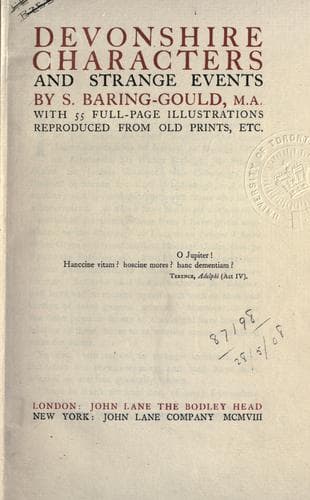
Devonshire Characters and Strange EventsBaring-Gould, S. (Sabine)
History
Devonshire Characters and Strange Events
Baring-Gould, S. (Sabine)
Devon (England) -- Biography; Devon (England) -- History
Finally, one touching trait in the character of Gifford was his
exceeding love for children. Looking back at his own desolate, loveless
childhood, full of hardship, his heart expanded towards all little
ones, and he delighted in attending juvenile parties, and rejoiced
at seeing the children frisking about in the happiness of youth. His
domestic favourites were his dog and his cat, both of which he dearly
loved. He was also most kind and considerate to his domestic servants;
and all who knew him well knew that his bark was worse than his bite;
he made no answer, did not retaliate when attacked vindictively,
insultingly by Hazlitt, and when William Cobbett called him “the
dottrel-headed old shuffle-breeches of the _Quarterly Review_” he cast
back no vituperative term in reply.
Gifford was a staunch friend. He left his house in James Street,
Buckingham Gate, to the widow of his old friend Hoppner, the portrait
painter.
Sir Walter Scott wrote on 17 January, 1827: “I observe in the papers my
old friend Gifford’s death. He was a man of rare attainments and many
excellent qualities. His _Juvenal_ is one of the best versions ever
made of a classic author, and his satire of the _Baviad_ and _Mæviad_
squabashed at one blow a set of coxcombs who might have humbugged the
world long enough. As a commentator he was capital, could he but have
suppressed his rancours against those who had preceded him in the
task; but a misconstruction or misinterpretation, nay, the misplacing
of a comma, was in Gifford’s eyes a crime worthy of the most severe
animadversion. The same fault of extreme severity went through his
critical labours, and in general he flagellated with so little pity,
that people lost their sense of the criminal’s guilt, in dislike of the
savage pleasure which the executioner seemed to take in inflicting the
punishment. This lack of temper probably arose from indifferent health,
for he was very valetudinary, and realized two verses, wherein he says
Fortune assigned him:--
One eye not over good,
Two sides that to their cost have stood
A ten years’ hectic cough,
Aches, stitches, all the various ills
That swell the devilish doctor’s bills,
And sweep poor mortals off.
But he might also justly claim as his gift the moral qualities
expressed in the next fine stanza:--
A soul
That spurns the crowd’s malign control,
A firm contempt of wrong;
Spirits above affliction’s power,
And skill to soothe the lingering hour
With no inglorious song.
“He was a little man, dumped up together, and so ill made as to seem
almost deformed, but with a singular expression of talent in his
countenance.”
Gifford was buried in Westminster Abbey, and his schoolfellow and
lifelong friend, Dean Ireland, was afterwards buried in the same grave.
Public-domain text, read in full here on John Shaqi.
Reviews
Reviews
No reviews yet
Be the first to share your thoughts on this work.
Elsewhere in the archive
Join the Discussion
Join the discussion
Sign in to leave a comment or review.
Sign InorCreate an account