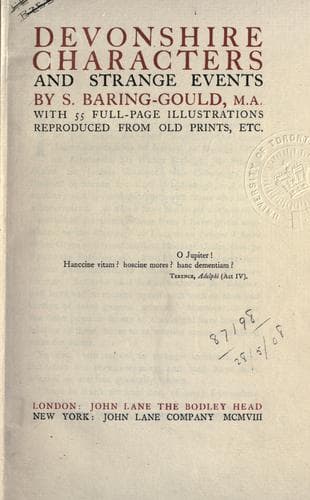
Devonshire Characters and Strange EventsBaring-Gould, S. (Sabine)
History
Devonshire Characters and Strange Events
Baring-Gould, S. (Sabine)
Devon (England) -- Biography; Devon (England) -- History
He had got £3000 receipts by exhibition of his picture “Christ’s
Entry into Jerusalem,” but had to sell it, being short of money, for
£240; and he was forced to dispose of his “Raising of Lazarus” to
Binus, his upholsterer, to clear off a debt, for £300. He certainly
did make a good deal of money, but was always in debt, often without
a shilling in his pocket. His huge canvases did not sell. He says of
them, in 1826, when Reinagle questioned him about them, “Where is your
‘Solomon,’ Mr. Haydon?” “Hung up in a grocer’s shop.” “Where is your
‘Jerusalem’?” “In a wareroom in Holborn.” “Where is your ‘Lazarus’?”
“In an upholsterer’s shop in Mount Street.” “And your ‘Macbeth’?”
“In Chancery.” “Your ‘Pharaoh’?” “In an attic, pledged.” “And your
‘Crucifixion’?” “In a hayloft.” “And ‘Silenus’?” “Sold for half-price.”
But he was incapable of bending his proud spirit to accommodate his
style to the popular taste. He besieged the ministers, he pestered
great men to get the Government to encourage High Art. If noble patrons
would not buy heroic pictures on huge canvases, the State should do it
to adorn public buildings. He took pupils,[22] who paid large premiums,
and he got them to back his bills, and involved them in heavy outlay
to meet them, and then pupils shrank from coming near him. He pestered
the nobility, all wealthy men for loans, for grants, for pecuniary aid
to help him out of immediate difficulties. He was arrested again and
again, and sent to the King’s Bench, had to appear in the Insolvent
Debtors’ Court, had distraints levied on his pictures, his furniture,
his books. He went about lecturing on Art, and these lectures brought
him in a respectable revenue, but he was ever underwater. How he
squandered his money does not appear in his journals; but he certainly
did earn sufficient with his brush to have maintained himself and his
family in respectability had he known how to economize. He got into the
hands of moneylenders, and was squeezed. He met with generous aid from
numerous quarters, but was no sooner relieved of one pressing call than
he fell into fresh difficulties.
If he were taken up by a noble patron and invited to his table, he
offended him by contradiction and rudeness. “I do not think I am liked
in company, except by women,” he admits in his journal.
The comic painting alluded to by Borrow was thus originated whilst
Haydon was in the Debtors’ Prison at King’s Bench:--
“I was sitting in my own apartment, buried in my own reflexions,
melancholy, but not despairing, at the darkness of my prospects and the
unprotected condition of my wife and children, when a sudden tumultuous
and hearty laugh below brought me to the window.
Public-domain text, read in full here on John Shaqi.
Reviews
Reviews
No reviews yet
Be the first to share your thoughts on this work.
Elsewhere in the archive
Join the Discussion
Join the discussion
Sign in to leave a comment or review.
Sign InorCreate an account