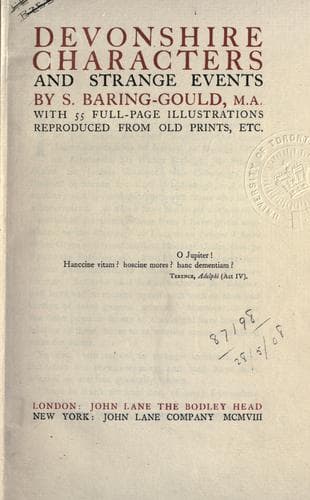
Devonshire Characters and Strange EventsBaring-Gould, S. (Sabine)
History
Devonshire Characters and Strange Events
Baring-Gould, S. (Sabine)
Devon (England) -- Biography; Devon (England) -- History
“Before me were three men marching in solemn procession, the one in the
centre a tall young, reckless, bushy-headed, light-hearted Irishman,
with a rusty cocked-hat under his arm, a bunch of flowers in his bosom,
his curtain-rings round his neck for a gold chain, a mopstick for a
white wand, tipped with an empty strawberry-pottle, bows of ribbons on
his shoulders, and a great hole in his elbow; on his right was another
person in burlesque solemnity, with a sash and real white wand; two
others, fantastically dressed, came immediately behind, and the whole
followed by characters of all descriptions, some with flags, some with
staffs, and all in perfect merriment and mock gravity, adapted to some
masquerade. I asked what it meant, and was told it was a procession of
burgesses, headed by the Lord High Sheriff and Lord Mayor of the King’s
Bench Prison, going in state to open the poll, in order to elect two
members to protect their rights in the House of Commons. I returned to
my room, and laughed and wept by turns! Here were a set of creatures
who must have been in want and in sorrow, struggling (with a spiked
wall before their eyes) to bury remembrance in the humour of a farce.”
He painted the scene of the “Mock Election in Prison,” and sold it to
the King for £525, after having made £321 by it in exhibition. Then he
painted another comic picture, “Chairing the Member,” for which he got
£422, beside £168 by exhibition. A third humorous picture was “Punch
and Judy.”
But though he made money by these paintings in the style of Hogarth, he
hated doing them. His soul soared to High Art.
“At the table of Mr. Wyatt,” says the Rev. J. Richardson in his
_Recollections_ (London, 1856), I met the late Mr. Haydon, the
artist, with whom I had been previously acquainted. Haydon was
undoubtedly a man of considerable talent, but of insatiable vanity.
He had concentrated in his own estimation of his merits those atoms
of admiration that ought to have been diffused among the general
community, who were certainly somewhat slow in recognizing the claims
which he was continually urging; indeed, they were far too slow to
satisfy his craving for applause, and for a slice or two of that
solid pudding which many people value much more than empty praise.
The consequence was that he was continually indulging in querulous
complaint and bitter vituperation; everybody was rewarded except
himself; nobody but himself had any merit or capacity or feeling for
Art. All the world were fools; he was the little bit of leaven that
was to bring the solid lump into fermentation; the one wise man whose
presence rescued the mass of mankind from unqualified insignificance
and fatuity. This inordinate vanity overlaid the many good qualities
which he possessed, blinded his perspicuity, and perverted his
judgment.”
Public-domain text, read in full here on John Shaqi.
Reviews
Reviews
No reviews yet
Be the first to share your thoughts on this work.
Elsewhere in the archive
Join the Discussion
Join the discussion
Sign in to leave a comment or review.
Sign InorCreate an account