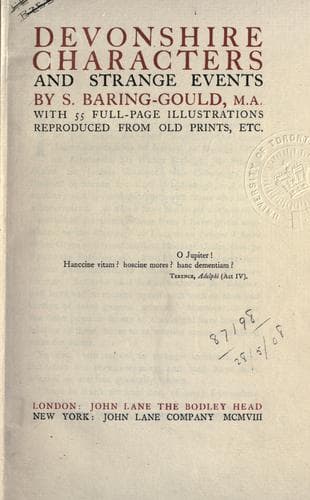
Devonshire Characters and Strange EventsBaring-Gould, S. (Sabine)
History
Devonshire Characters and Strange Events
Baring-Gould, S. (Sabine)
Devon (England) -- Biography; Devon (England) -- History
This was a wound so severe to his vanity that it never healed. He
abused the public, contrasting his own merits with those of his
diminutive rival, and mixing up the sublime with the ridiculous in such
a manner as to make his complaints the source of laughter rather than
of commiseration. He was at some moments in so excited a condition from
his own disappointment, contrasted with the success of the dwarf and
the showman, that he appeared to his friends to be almost insane.
On 22 June he wrote in his diary the lines from _Lear_:--
Stretch me no longer on this rough world.
This was written between half-past ten and a quarter to eleven o’clock
on that morning. He was in his studio. About a quarter to eleven
his wife and daughter heard the report of firearms, but took little
notice of it, as they supposed it to proceed from the troops then
exercising in the Park. Mrs. Haydon went out. Miss Haydon entered
the painting-room, and found her father stretched dead before the
easel on which stood his unfinished picture of “King Alfred and the
First English Jury”--his white hairs dabbled in blood, a half-open
razor smeared with blood at his side, near it a small pistol recently
discharged, in his throat a fearful gash, and a bullet-wound in his
skull. A portrait of his wife stood on a smaller easel facing his large
picture. On a table near was his diary open at the page of that last
entry, his watch, and a Prayer Book open at the Gospel for the Sixth
Sunday after the Epiphany, and his will.
The coroner’s jury found that the suicide was committed when Haydon
was in an unsound state of mind. In fact, he had been driven mad by
mortified vanity. His debts at his death amounted to about £3000. The
assets were inconsiderable. Liberal and immediate assistance and much
sympathy were extended to the bereaved widow and family.
Posterity has not seen occasion to reverse the judgment of his
contemporaries on Haydon’s paintings.
His engrossing love of art, with his consciousness of great powers,
and excessive self-esteem, made him a most enthusiastic devotee to
any work which he had on his easel, and enabled him to bear up long
against the thousand interruptions from embarrassed circumstances which
are detailed in his _Autobiography_. Whilst painting his “Maid of
Saragossa” he accidentally wounded his foot with a bayonet, but went on
with the picture, using his own blood as a pigment, till the surgeon
arrived.
Public-domain text, read in full here on John Shaqi.
Reviews
Reviews
No reviews yet
Be the first to share your thoughts on this work.
Elsewhere in the archive
Join the Discussion
Join the discussion
Sign in to leave a comment or review.
Sign InorCreate an account