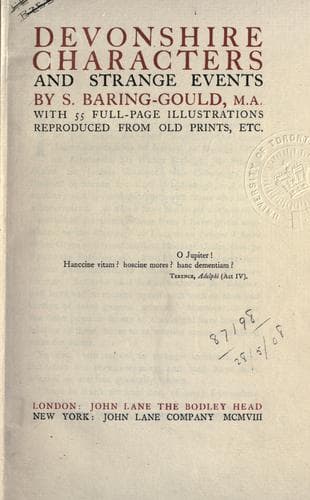
Devonshire Characters and Strange EventsBaring-Gould, S. (Sabine)
History
Devonshire Characters and Strange Events
Baring-Gould, S. (Sabine)
Devon (England) -- Biography; Devon (England) -- History
Zeal, devotion, high thoughts, ability in composition, some power in
colouring, and correct anatomical drawing may and ought to be conceded
to Haydon. But he aimed at subjects beyond his power of execution, and
in all his High Art paintings there is a lack of refined feeling and
good taste. Thus, in the “Judgment of Solomon” the king is depicted
as treating the whole affair as a practical joke. Mr. Watts, the
artist, says: “The characteristics of Haydon’s art appear to me to be
great determination and power, knowledge and effrontery. His pictures
are himself, and fail as he failed. In Haydon’s work there is not
sufficient forgetfulness of self to disarm criticism of personality.
His pictures are themselves autobiographical notes of the most
interesting kind; but their want of beauty repels, and their want of
modesty exasperates. Perhaps their principal characteristic is want
of delicacy of perception and refinement of execution. His touch is
generally woolly, and his surface disagreeable.”
He was determined to force his idea of the Heroic in Art on a public
that had got beyond gods and goddesses and the heroes of the Greeks and
Romans. He would have done well at the Court of Louis XIV, but he was
out of date at the dawn of the naturalism of the nineteenth century.
The public, thought Haydon, were sick, and knew not what Art was. They
must be forced, scolded, lectured, rated to admire it. The last thing
that would occur to him would be to study the trend of public taste and
to adapt himself to it.
When drawing his cartoons for the Houses of Parliament, he would not
even consider what was fitting. Had he sent in his “Alfred and Trial by
Jury,” it might and probably would have been approved; but instead he
sent pictures from the Reign of Terror in France to represent Anarchy,
which was of all things unsuited for the new palace, that did not
desire scenes from French history, and those recent ones.
And his huge cartoons were a mistake. Epics are not for the masses,
and only great public buildings could contain these canvases. Public
bodies did not care to spend large sums upon pictures for town halls
and exchanges.
“What a game you have thrown away!” said a friend to Haydon one day;
and we must echo that opinion in considering the life before us. It was
a game utterly and irretrievably, through vanity and pig-headedness,
thrown away.
JOHN COOKE
By a public character in his way
You may find an anecdote of the day,
I wish every line to tell, and word I say.
Thus “Captain” John Cooke, the Exeter saddler, begins his pamphlet,
_Old England for Ever_, published by Curson, of Exeter, in 1819.
Public-domain text, read in full here on John Shaqi.
Reviews
Reviews
No reviews yet
Be the first to share your thoughts on this work.
Elsewhere in the archive
Join the Discussion
Join the discussion
Sign in to leave a comment or review.
Sign InorCreate an account