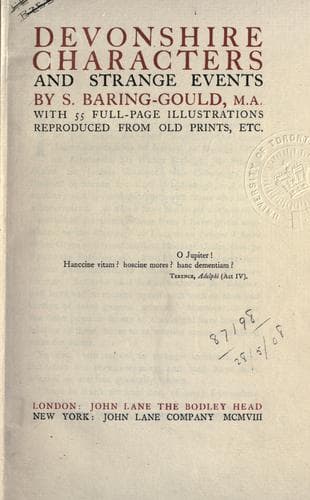
Devonshire Characters and Strange EventsBaring-Gould, S. (Sabine)
History
Devonshire Characters and Strange Events
Baring-Gould, S. (Sabine)
Devon (England) -- Biography; Devon (England) -- History
John Cooke was born at the “Rose and Crown” public-house, on the old
bridge, at Ashburton, in 1765. Ashburton, says Cooke, was not only
famous as producing Dunning, Lord Ashburton, but also for its Pop. “I
recollect its sharp feeding good taste, far richer than the best small
beer, more of the champagne taste, and what was termed a good sharp
bottle. When you untied and hand-drew the cork it gave a report louder
than a pop-gun, to which I attribute its name; its contents would fly
up to the ceiling if you did not mind to keep the mouth of the stone
bottle into the white quart cup; it filled it with froth, but not over
a pint of clear liquor. Three old cronies would sit an afternoon six
hours, smoke and drink a dozen bottles, their reckoning but eightpence
each, and a penny for tobacco. The pop was but twopence a bottle. It is
a great loss to the town, because its recipe died with its brewer about
1785.”
[Illustration: CAPTAIN COOKE, 1824, AGED 58
_Drawn from Nature, on the stone by N. Whittock_]
Another drink of the past was white ale. This derived its name from
its appearance, not unlike tea freely diluted with milk and having
considerable quantities of some white curdy substance floating about
in it, which had a tendency to settle at the bottom of the glass. The
secret of its composition lay in the nature of the ferment employed,
called “grout.” At one time white ale was a common drink in South
Devon; now it is as dead as Ashburton Pop and John Dunning.
John Cooke’s father was a plasterer and “hellier”--i.e. slater--but
turned publican and maltster, and kept the tavern in which his son
was born. John’s grandfather brought the water into the town to the
East Street conduit. At the age of fifteen his mother, then a widow,
put John apprentice to Chaster, a saddler in Exeter, and on the death
of Chaster, Cooke succeeded to the business at the age of twenty-one,
and was highly esteemed in the county for the excellence of his work
and his knowledge of how to fit the back of a horse. He made saddles
for Lord Rolle, Sir Stafford Northcote, Sir John Duntze, Sir Robert
and Sir Lawrence Palk, Sir Thomas Acland, and last, but not least,
for Lord Heathfield. “His lordship was allowed to be one of the best
judges of horses and definer of saddlery in the kingdom; his lordship’s
saddle-house consisted from the full bristed to the demi-pick, Shafto,
Hanoverian, to the Dutch pad-saddles; and from the snaffle, Pelham,
Weymouth, Pembroke, Elliott, Mameluke, and Chifney bridles. His
lordship’s saddle and riding-house was a school for a saddler and
dragoon.”
Cooke breaks into rhyme:--
Public-domain text, read in full here on John Shaqi.
Reviews
Reviews
No reviews yet
Be the first to share your thoughts on this work.
Elsewhere in the archive
Join the Discussion
Join the discussion
Sign in to leave a comment or review.
Sign InorCreate an account