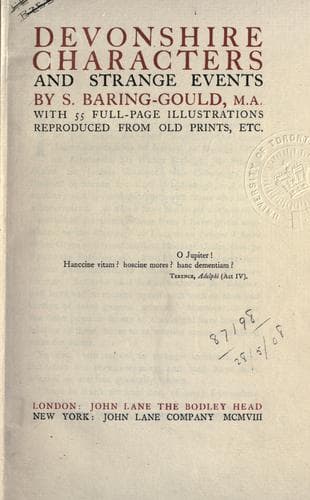
Devonshire Characters and Strange EventsBaring-Gould, S. (Sabine)
History
Devonshire Characters and Strange Events
Baring-Gould, S. (Sabine)
Devon (England) -- Biography; Devon (England) -- History
The Saverys had acquired Shilston in Modbury at the end of the
sixteenth century, and resided there till the middle of the nineteenth.
Colonel Christopher Savery’s youngest son is said by Mr. Smiles, in his
_Lives of Boulton and Watt_, to have been Richard. But Richard does
not appear in the pedigree in Colonel Vivian’s _Visitations of Devon_.
This is, however, no proof that Smiles is wrong. Richard Savery was
the father of Thomas, who was born, according to Smiles, at Shilston
about the year 1650. He was educated to the profession of a military
engineer, and in course of time reached the rank of trench-master. The
pursuit of his profession, as well as his natural disposition, led
Savery to study mechanics, and he spent all his spare time in executing
mechanical contrivances of various sorts. One of the first of these was
a paddle-boat worked by men turning a crank. He spent £200 on this,
and built a small yacht on the Thames to exhibit its utility. But when
submitted to the Admiralty they would have nothing to do with it, as
its practical utility was doubtful. The power of wind was better than
hand labour in propelling a vessel; and although his machine might
answer on a river, it was extremely doubtful whether it would succeed
even in a moderately rough sea.
Dissatisfied at the reception of his paddle-boat by the naval
authorities, Savery gave no more thought to it, and turned his
attention in another direction.
The miners in Cornwall had been hampered by water flowing into their
workings. When the upper strata had become exhausted they were tempted
to go deeper in search of richer ores. Shafts were sunk into the lodes,
and these were followed underground, but very speedily had to be
abandoned through the influx of water. When the mines were of no great
depth it was possible to bale the water out by hand buckets; but this
expedient was laborious and ineffectual, as the water gained on the
men who baled. Then whims were introduced, and by means of horse-power
water was drawn up. But this process also proved to be but partially
effective: in one pit after another the miners were being drowned out.
In the fen lands water was drawn up out of the drains and pumped into
canals by means of windmills; and it is to this that Ben Jonson alludes
in his play _The Devil is an Ass_, 1616, when he makes Fitzdottrell
say: “This man defies the devil and his works. He does it by engines
and devices, he! He has ... mills will spout you water ten miles off!
All Crowland is ours, wife; and the fens, from us, in Norfolk, to the
utmost bounds in Lincolnshire.”
But the use of wind as a motive power does not seem to have occurred to
the Cornish miners, or perhaps it was thought to be too uncertain to be
of much value for pumping purposes.
Public-domain text, read in full here on John Shaqi.
Reviews
Reviews
No reviews yet
Be the first to share your thoughts on this work.
Elsewhere in the archive
Join the Discussion
Join the discussion
Sign in to leave a comment or review.
Sign InorCreate an account